2025 Foreword
You are about to read one of the strongest posts I published to date. Reading it again after almost seven years is insightful for me as well. For instance, I had forgotten that this article was written on Christmas Day.
Back then, I was sharing my early insights about the startup ecosystem — my first attempts to articulate patterns that today are obvious to me. I remember my friend Marcel telling me that I sounded arrogant. Maybe I did, maybe I didn’t. You can judge for yourself. I’m republishing this piece to show you my former mind: the proto‑version of who I would later become.
This post aged like good wine. Several of the niche ideas I described were later built by others. As we speak, I regularly use a tool that extracts hardcoded subtitles from movies into text files — exactly the type of product I predicted. It saves me tens of hours of work.
Even if just this one idea made it into reality, it proves something essential: I have always been able to spot opportunities lying openly on the sidewalk.

Happy reading!
Startups fascinate me. It's tough to succeed, and this is the reason why I dream of building one. According to the Fortune article, 90 percent of startups fail within a year. As a primary reason, they state "No Market Need," a staggering 42 percent.
When I look at the startup scene, I see too many startups competing for the same customers. At the moment, several startups build yet another social network or video streaming platform, not to mention the plethora of existing platforms out there.
Just the other day, I read about the Paris-based startup Yubo, which develops a video platform for Gen Z. They secured €11 million in funding to expand globally. Honestly, I will be surprised if they'll outlive five years from now.
I also see many startups obsessed with augmented reality. They think about how cool the technology is and what a revolutionary product they develop — a product which will change the world as we know it.

The reality is that often such startups don't ask the people for their opinions and often end up with a product no one wants. They may experience an unpleasant surprise one day!
Lastly, the advent of machine learning has stimulated the creation of many startups, in which the founders are experts in the field and don't know where to apply their expertise meaningfully. Hence, they copycat the other popular startups in the ML world and hope to beat them someday.
I don't understand this. Building a startup is hard. Why make it harder by competing with ten companies who do a similar product to yours? I believe that to increase the chances to survive, startups should focus on markets with only a handful of competitors or even better find a market where you are the only one.
A niche market is a key to succeed
Building your product for a small but very specialized customer base has many benefits.
Imagine that you make a living as a content creator and social media influencer. Each day you produce videos for YouTube and write blog posts on Medium at least once per week. To let the world know of your content, you write daily posts on Twitter and Facebook and publish photos on Instagram. To grow your influence, you try to engage with your audience by responding to their comments. Also, you know that your audience on Twitter is mostly from the US and is most active in the evenings, and your audience on Facebook is most active during lunchtime.
You spend hours dealing with social networks, and you have no one to help you with it. One day you'll find a new product which allows you to schedule your posts for all social networks and which also aggregates comments into one single app. As imperfect as the application is, you'll happily use it and tolerate all its quirks.
As the startup providing the software, you'll easily convince your users to be your beta testers for free. They will often overlook small issues with your product and will happily use it because it makes their life more comfortable. Such people will recommend your product to others, and one day you'll have a stable user base.
I will give you a few particular examples of what I mean by the niche market. I'm positive that if you create a product in these segments, you'll have a solid chance to be profitable. Maybe you'll not earn millions, but you can have a decent living out of it.
Example #1: A video demuxing and editing tool
I've been recording TV shows since high school. First on VHS, later by capturing the digital broadcast stream and processing it. I'm by far not the only one who does that to this day.

There are two common digital standards, DVB in Europe and ATSC in the US. The point is that you'll receive all the TV live streams within one huge transport stream, which you store in a big file, and you need to process this file. It usually contains one or more video streams, multiple audio streams, subtitles, and other data streams. Also, most likely, it includes scrambled packets or packets with errors.
Usually, you want to select individual streams from this file, cut out the commercials, process the data to not contain invalid packets, and make sure that audio and video stay in sync.
In the old days, we all used an open-source tool called ProjectX. It supported elementary stream repairs, including audio/video synchronization; it provided essential video cutting tools and allowed us to demux the transport stream into individual files. Developers stopped working on the application years ago, and people stopped using it as soon as the TVs transitioned to HDTV. ProjectX supports only standard definition files with MPEG2 video codec.

Nowadays, most of us use a tool called TS-Doctor. It has the same functionality, but this time it's commercial. At the time of writing, a single-user license costs almost €35. This tool is by far not perfect. It often crashes, has UI errors, occasionally hangs, and supports Windows only. However, we still use it because there's nothing better.
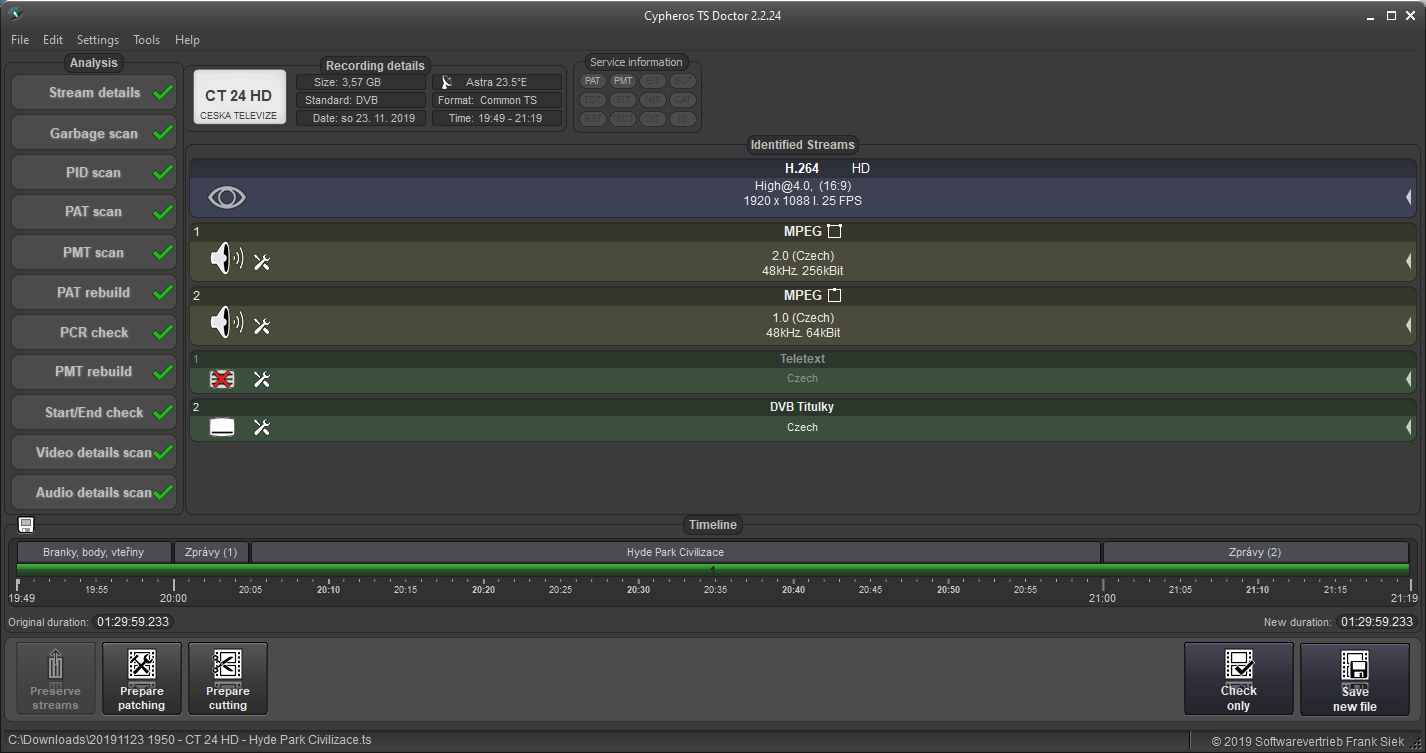
Do you see the power you could have if you're the only one providing value to a specific group of people? It's worth mentioning that just one guy develops this tool. Imagine what you could accomplish with a team of people.
Another tool we often use is called VideoReDo. It allows us to cut out commercials from the video stream without re-encoding the whole file. People use this application because TS-Doctor is inaccurate in video editing. You can achieve the best results by combining these tools.
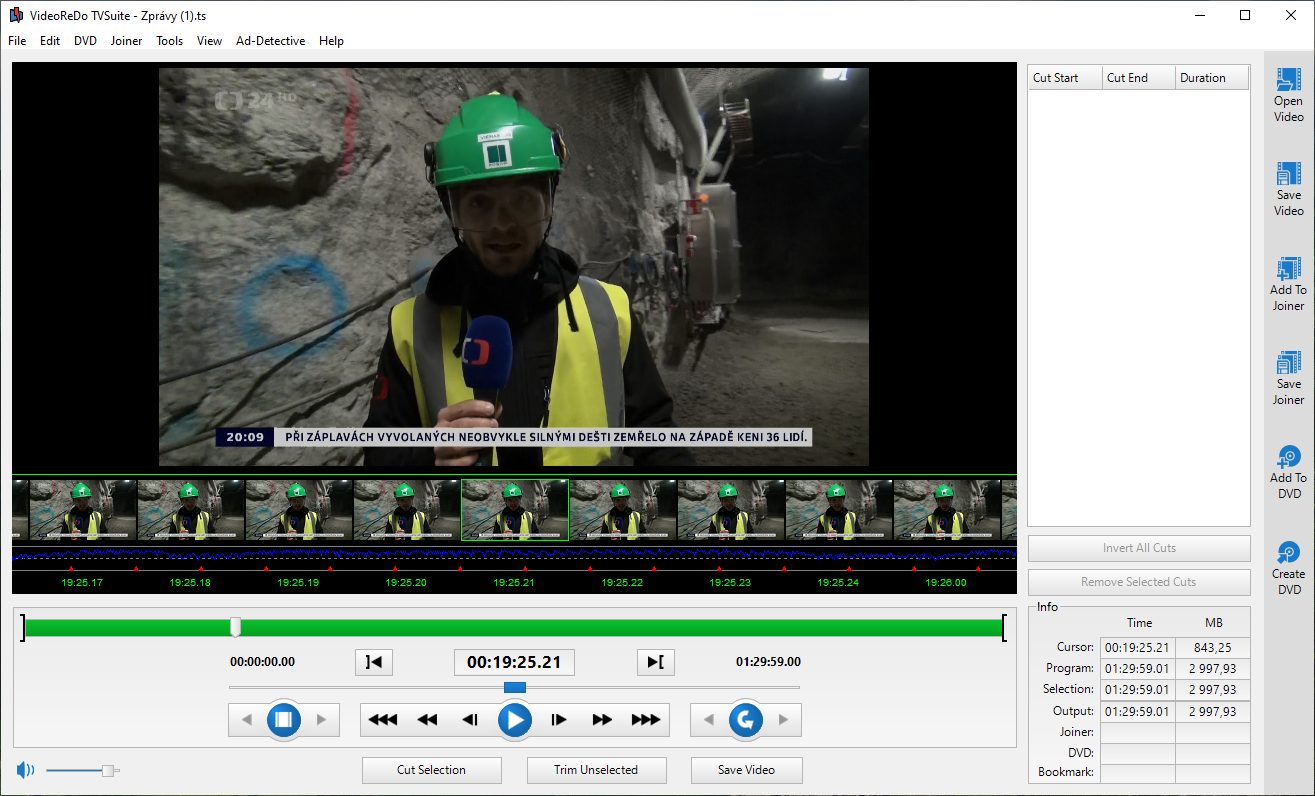
A commercial license for VideoReDo costs almost $100, and I bet this software is developed only by a couple of developers. Also worth noting that they make a new release of the application only a few times a year, and usually it contains just bugfixes and compatibility improvements. Nothing significant.
Now imagine you could build a product which combines the most required functionality from both of these tools. Even with a small team, you can write the software in a relatively short time and be on par with the functionality of TS-Doctor. Not only that, you could seize the whole market. The competitors are dormant, don't innovate, and yet they're profitable because others build just another 3D reality framework or Instagram AR filters.
Example #2: A subtitle transcribing tool
This second example is from a similar area like the first one. Often you record a video which contains hardcoded subtitles directly in the video. Sometimes you'll find such subtitles when you watch a movie in English, and suddenly the actors speak a foreign language. Another example is anime. It often contains hardcoded English or Japanese subtitles.

Your target audience is the fansubbers — people who translate the subtitles for free just because it's fun. To create the subtitles in their language, they need to have the original captions in a format which contains original text and timing — when to show the lines and for how long. You would be surprised, but often they transcribe the original subtitles manually, line by line.
You'll need to solve two problems:
- Reliably detect if a movie contains hardcoded subtitles
- Reliably transcribe the words, including correct timing. For parts where your software is uncertain, provide an easy-to-use interface for the user to fix the parts manually.
If you're able to automate both tasks reliably, you'll win a vast customer base. I'm sure many of them would pay a few bucks a month if your application saves them hours of work.
At the moment, I know of one free Windows app to help with this task, but it isn't accurate at all. Also, it's slow. It needs to go through every video frame and analyze it, which takes a lot of time.
I'm sure there are better ways to detect the presence of hardcoded subs, and transcribing speed could also be improved, not to mention accuracy.
The OCR techniques used by the tool are elementary. If you'd integrate OCR engines like Tesseract, license an engine from companies doing OCR recognition on scanned documents, or even improve the OCR recognition with the help of AI, you'll have a much better product — state of the art in this segment!
With proper pricing, you should be profitable in a relatively short time, and potentially you could offer the technology or parts of it also to TV broadcasters.
Example #3: Sign language interpretation tool
Did you ever wonder what hearing-impaired people are talking about with the signs? I certainly did. Imagine an app for iPhone and Android phones capable of looking at the signs and interpreting them as text or voice.

Over time, when augmented reality becomes more prevalent, the interpretation of the signs could be shown in your glasses. Machine learning will be a perfect choice to tackle sign language interpretation.
The main issue I see is that sign language is not standardized. There are different sign languages, just as there are different spoken languages. However, if you solve this, you will have software which:
- Translates amongst different sign languages as text or synthesized voice
- Allows people who don't know sign language to ease communication with such a person
- Gives the possibility of communication between hearing-impaired and blind people. Hearing-impaired people will be able to read lips, and blind people will hear the synthesized voice.
Even if you don't solve the most significant problem — translating among different sign languages — you can focus on the most dominant ones, such as those used in the USA, United Kingdom, Spain, or France.
Again, this tool would bring immense value to customers, and with proper pricing, you'll earn money in no time.
Example #4: Transcription of spoken word from mute videos
A software capable of transcribing spoken words out of silent videos will find its use in various surveillance cases. I'm sure you could come up with more use cases.
You can solve this challenge with machine learning algorithms. In this field, there is already some progress; AI is already better at lip-reading than humans. Google is working on it, also MIT and Stanford, maybe a few others. But I'm sure a young startup will find its place easily.
Example #5: Music sheet creation tool
I got the idea for the last example while watching YouTube. A YouTuber named Tantacrul, who is a composer and UX designer based in London, reviewed some tools for creating sheet music.

In his videos, Tantacrul reviewed the most popular software and found significant shortcomings in each of them. He also mentions that you can still find musicians who write sheet music with pen and paper. I'm sure there is a huge opportunity to innovate. It turned out that there are only a few companies on the market; their software suites have existed for decades, and these companies are not motivated to innovate.
I thought of pursuing the idea of creating revolutionary software in this area. However, at this time, I work on something else. Feel free to grab the idea if you want.
How to find niche markets
There is no universal rule. However, I'll try to provide a few hints. First, keep your ears open. You'll be surprised how many ideas you get just by listening carefully. Second, expand your professional network. Try to get to know people from different areas of expertise. They often have problems in their work, and you could provide a solution. Third, go to various meetups. Prefer meetups in your field of expertise, but also go to meetups where people discuss other areas. If you're a developer, go to accountant meetups, lawyer meetups. Just go out there and meet people!
Conclusion
I believe in the power of niche markets, and I'd like to know your experience. If you feel inspired by some of the ideas mentioned above, build on them. I wrote this post because I focus on things not mentioned here. I have plenty of them. Also, if you use them, let me know about it so that I can track your progress. As always, feel free to leave comments below.