2026 Foreword
This post already felt deeply retrospective when I wrote it almost six years ago. Today, the sense of nostalgia is even stronger. It captures my beginnings and some of the influences that shaped who I am now.
I’m sure that if I had been born elsewhere, I might never have discovered Merkur. Still, a curious mind like mine would have found another outlet — perhaps LEGO Technic, had I grown up in the US.
I continue to wholeheartedly agree with the conclusion. Construction sets like Merkur help develop creativity and practical thinking. Today, we have far more options — and even access to real problems to solve. As long as it’s fun and engaging for you, go for it. Even adults are allowed to remain children when it truly matters.
Toy cars and construction sets intrigued me since I was a little boy. When I was five years old, I already tried to repair broken toys. Disassembling and fixing toys was more fun for me than just playing with them! No wonder I ended up being a programmer. I grew up in a post-Soviet state; everything was in turmoil. When I was growing up, we didn't have money or opportunities to spend it. There was no LEGO Technics or other Western toys. Instead, we had our own, made in former Czechoslovakia.
From SEVA to Merkur and beyond
When I came into kindergarten as a three-year-old, I fell in love with the SEVA construction set. It was made entirely out of plastic and had only three types of parts: blue plastic bars, white bolts, and covers with different colors. You can look it up; as I found out, it's made to this day. I played with it for a couple of years. Then, as I went into elementary school, I gradually wanted a more advanced construction set. One day I heard about Merkur; this was the upgrade I desperately needed. It had most of the parts made of metal, and you could join them with proper screws. In the packaging, I also got my very first screwdriver, which I sometimes use to this day.
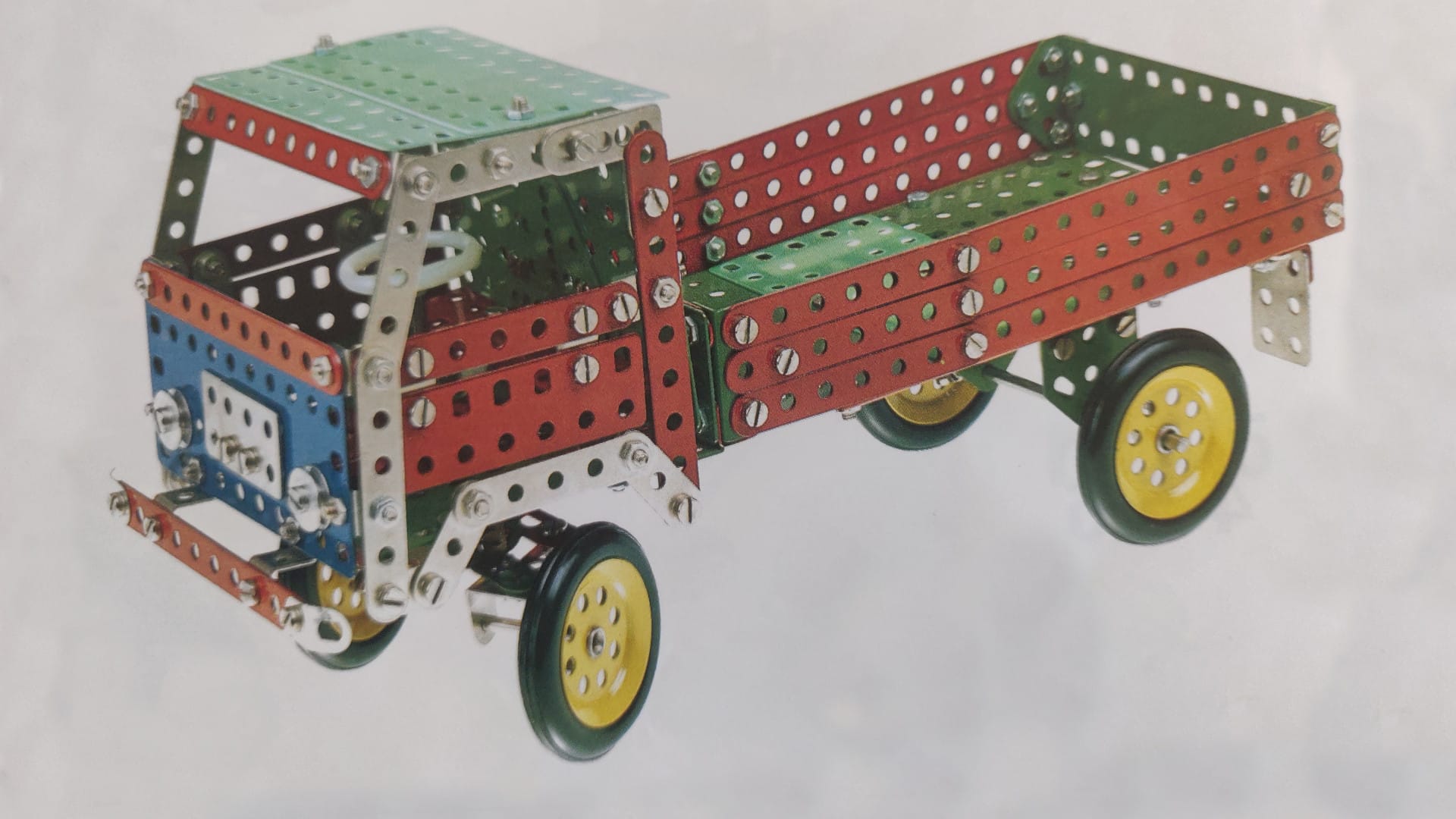
There were several Merkur construction sets to buy. The main ones were labeled like Merkur 1 through 8 (I believe), which represented different levels. First, you started with basic models in Merkur 1; later, your parents bought you Merkur 2, where you could re-use parts from Merkur 1, etc. Each box had its own printed manual with pictures and guidelines on how to build concrete models. However, in my case, I didn't have eight boxes of parts — I had only two. Many models in the book were out of my limits because I missed some parts. Because of it, I had to imagine my own models to build. It seems to me like a useful skill to have, especially today. As a second benefit, I became skilled in manual work, which came in handy later as I started building and repairing computers as a twelve-year-old. Sometimes I do it to this day, but only for my close friends.
One day I tried to build a small airplane out of Merkur. This time, I had a small electric motor powered by batteries, which rotated all the propellers with a rubber band. Later, I rebuilt it into a helicopter. Funny story: as I was pressing the switch and the motor was running, the TV broadcast was heavily distorted. I felt like I had tremendous power in my hands.
Stories like mine are plentiful! Merkur influenced many generations. When I visited my uncle, he played with this construction set even more. His models were more advanced, but that's not the point. We all had our share of fun! Over time, as I grew older, I lost interest in this set, and I stored it in our loft, where it stayed for years until recently. My cousin Aleš told me that he could use Merkur parts with Arduino, and I happily agreed to hand this set to him and to breathe new life into it.
How the world sees us, Merkur edition
"Jak nás vidí svět" (or How the world sees us) is an online documentary video series produced by a Czech internet TV Stream.cz. In each episode, they give foreigners in Australia Czech food or drinks to taste, or products to try. Australians then say what they think about them. In one episode, the creators gave foreigners the Merkur construction set to play with.
Here are top highlights from the show:
- Many participants were too lazy to do anything with the kit; they lacked patience, they gave up very early, and they were unable to commit to hard work
- One girl literally complained that she couldn't build anything with this kit because she is a girl (interesting!)
- Most of the participants seemed not capable of making even an IKEA furniture (just my observation)
- For most of them, this was a waste of time
- Some of the participants were almost hurt while using a screwdriver
- Some were afraid that sharp pieces could harm the kids, or be dangerous in some way
- One girl literally suggested that you can kill someone with the parts, and said she wouldn't buy it for her kids because it's too dangerous!
- Some called it a fake Czech LEGO
- One girl said that she hated it, and she was willing to bet that even boys would prefer computer games to Merkur
- An Indian girl surprisingly showed a great interest in Merkur. And she actually made the car in the picture. Very impressive and kudos to her commitment!
In my case, Merkur helped build a beneficial skillset. When I hear these adults talking about some dangerous toy, it hurts! Throughout history, many generations played with it and were just fine. And now we have a generation of people who don't have enough patience to play with it, to build something creative out of it. We have a generation that sees Merkur as something dangerous, something that these people won't buy for their kids even if they had a chance! It makes me think: what will our next generation look like? Many people already lack essential skills, and my guess is that it won't change for the better soon! We are literally the Snowflake generation. Now it's time to change that. We still have skilled people around. Ask them to teach you. One day they'll perish, and their skills will die with them. Think: what would you do without the Internet? Could you at least change tires on your car?
Arduino + Merkur = ♥
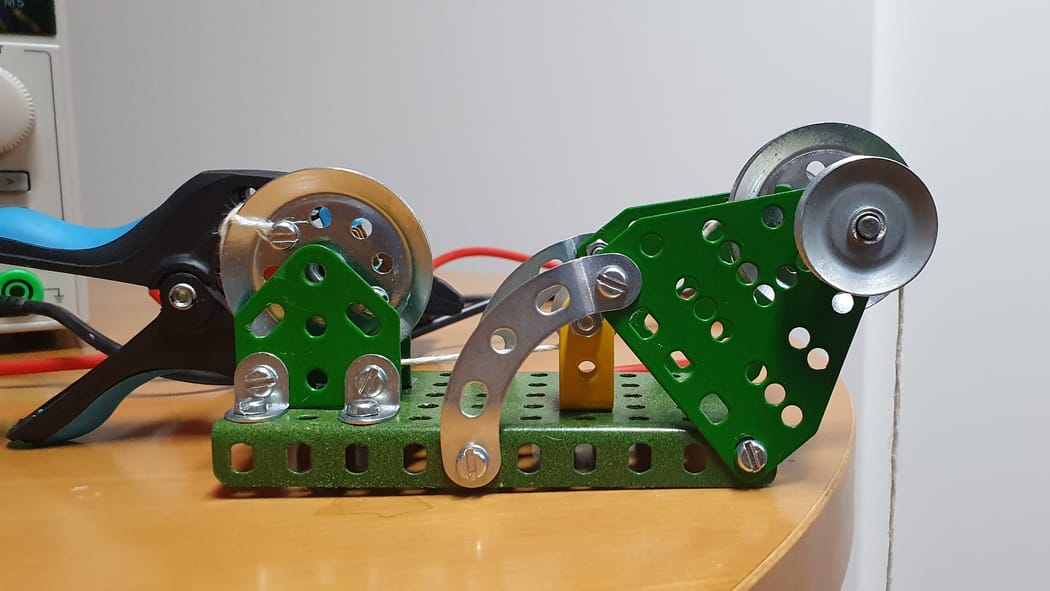
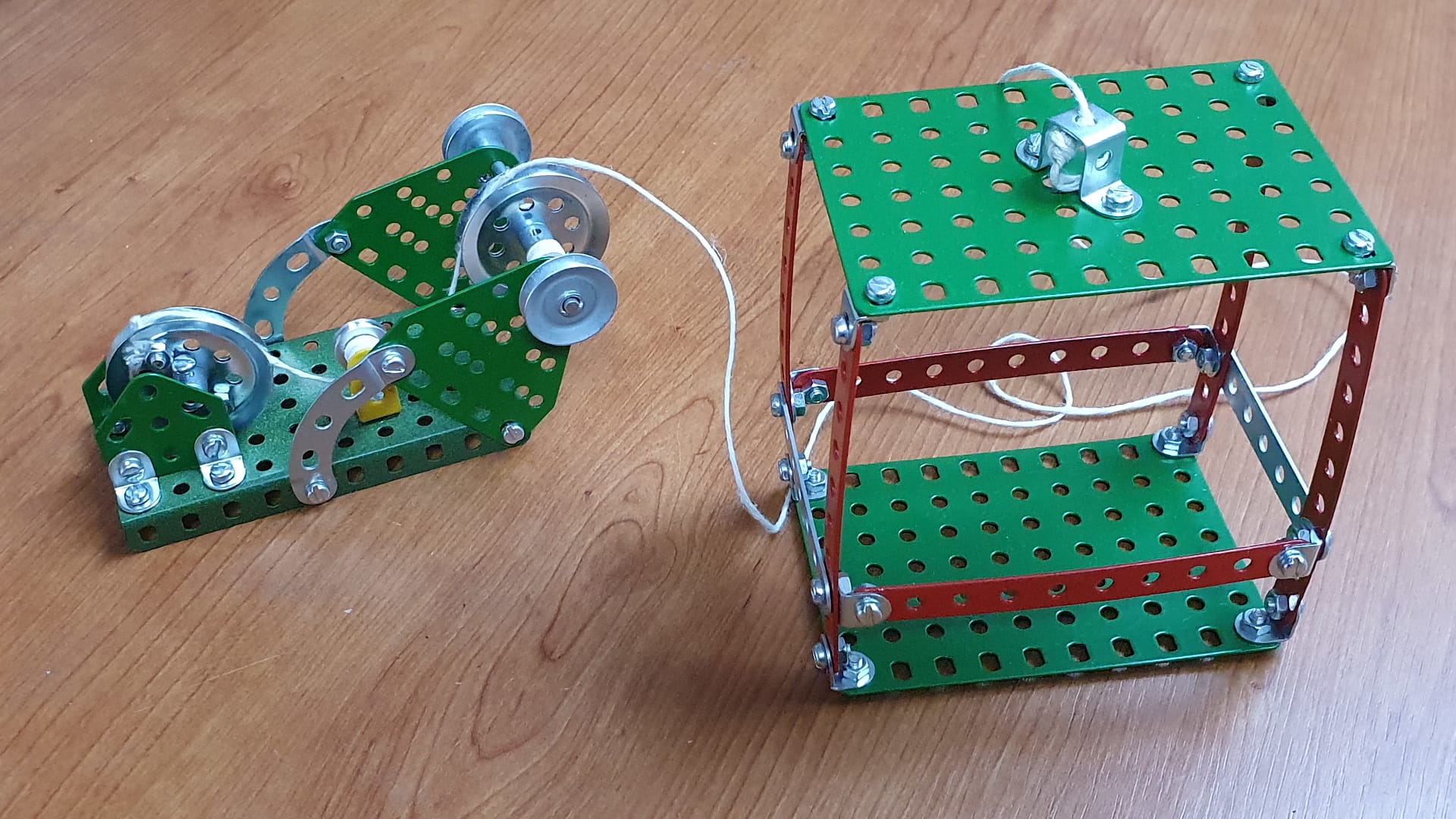
To finish in a positive spirit, let me give an example of how to use Merkur to boost your creativity. As I already mentioned, I gave my kit to my cousin Aleš. If you read my older posts, you probably know that we're building products with Arduino. It turns out that Merkur is a perfect fit for that. For example, you're building a device that can remotely open or close a garage door. Instead of testing the product in real conditions, you can test it in a lab, and you can build the garage door out of Merkur. The Arduino board is the same; only the real conditions are scaled down so that you can fine-tune your product at your convenience. The result is impressive!
Arduino-controlled garage door prototype built using a Merkur construction set.
Conclusion
Merkur is a fantastic kit, which boosts your creativity and helps to develop your manual skills. If you try, you can build many great things, perhaps even show them in public exhibits. Try not to make judgments too early and experiment! This is a driving force in our society. At last, Merkur is made to this day. Feel free to check it out, and if you buy a kit, I will happily hear about your experiences and accomplishments. Happy tinkering!