My favorite book author and YouTuber, Aaron Clarey (if you know, you know), once opened a topic about fake CEOs on LinkedIn. In his words:
“Everyone is a CEO these days.”
And he was right.
You’re not a CEO until you actually have someone to lead.
Founding a company is easy.
You fill out a form, pay a few hundred euros, and suddenly you own a legal entity. For many, that’s enough to claim the title CEO/Founder of SomeRandomUnheardCompany — with zero employees.
Solopreneurs and wannapreneurs claiming these titles out of ego dilute their meaning.
The same thing happened to my engineering title from university. Over the years, I watched graduates walk out with the same title but with noticeably weaker fundamentals. The title remained the same; the meaning did not.
That’s how inflation works — too much supply, lower perceived value.
(If any economists here want to calculate the “LinkedIn CEO inflation rate,” please do. I’d be curious.)
My Choice: A Different Path
Yes, I own a company.
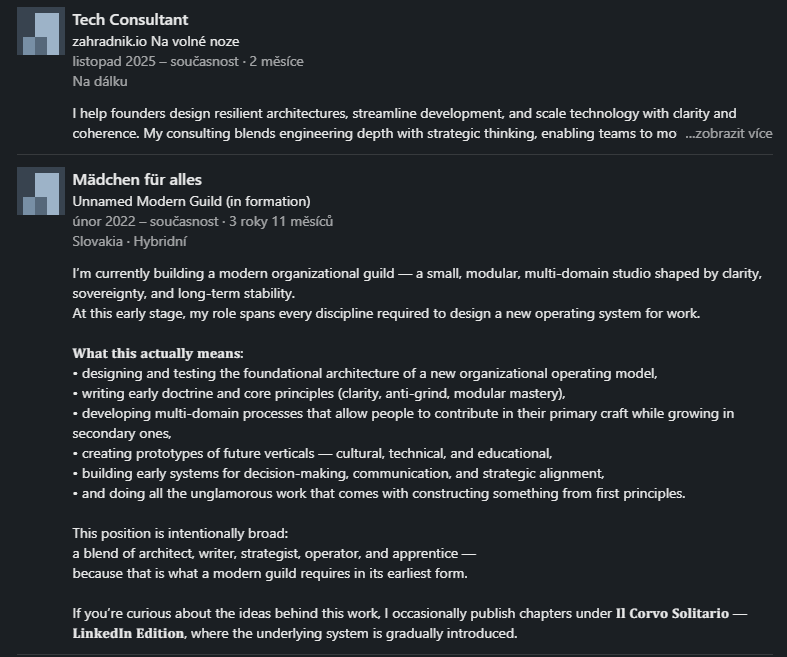
But if you check my profile, I’m not even referencing it by name.
Revenue is still modest, internal structures are still forming, and claiming the CEO title right now would feel… premature.
I even considered not listing the position at all.
But since my posts make it obvious that I’m building something, I chose a different approach — one that arrived at 3 AM, as most of my best ideas do:
I gave myself the title “Mädchen für alles.”
For the non-German speakers: “the girl for everything.”
In other words: the person who does whatever needs to be done — designing, writing, directing, marketing, cleaning up after the messes nobody sees.
A playful jab at myself.
A reminder not to take titles too seriously.
And a small signal that I’m building something real, from first principles.
What Will the Future Bring?
If my model proves scalable, I might one day adopt the CEO title — but only externally.
Inside the realm I’m building, the old corporate titles don’t fit.
The traditional C-suite reflects the system I’m reinventing, not the one I’m creating.
I respect people who earn these titles. Truly.
But I believe new organizational models require new language.
In my modern guild, we will have:
- Masters
- Apprentices
Just like in the original guilds.
Every Master will have a specifier:
Master of Marketing, Master of Embodiment, Master of Architecture, etc.
Internally, these will be our real roles.
Externally, for documents and legal clarity, we’ll translate them:
| Internal Title | Public Title |
|---|---|
| Master of High Works | CEO |
| Master of Marketing | CMO |
| Master of Organizational Design | COO |
For programmers:
Think of this as private variables vs public API.
My Titles? I’ll Give You Two.
- Master of High Works — a playful reinterpretation of an old French title.
- Il Commendatore — a nod both to Enzo Ferrari and to the slain commander in Mozart’s Don Giovanni.
These aren’t corporate titles.
They’re part of the internal mythology of the realm I’m building — a reminder that companies can be more human, more creative, more story-driven.
Your Turn
Corporate culture doesn’t have to be rigid.
Even a small dose of creativity reshapes the atmosphere.
Rome wasn’t built in a day — and no meaningful culture ever is.
So tell me:
👉 If you could create your own working title — playful or serious — what would it be?
Drop your best ideas in the comments. Let’s make this fun.