This article is written for the minority of my readers who are generalists.
The rest of you may treat it as a glimpse into a different operating system.
Half of 2026 is already behind us, which makes it a good time to reflect on what worked, what failed, and what I learned from both.
For years I assumed that progress required focus.
Not just priorities, but full commitment.
Pick one thing.
Ignore everything else.
Push hard.
That advice works remarkably well for many people.
The problem is that I am not one of them.
Besides my professional work, I learn languages, play music, dance tango, hike, ride a motorcycle, exercise regularly, write articles, prepare community projects, and constantly explore new ideas.
A few months ago, I decided to run an experiment.
I would focus primarily on one area of personal growth.
Not because I was dissatisfied with the others, but because I wanted to test whether concentrated effort would accelerate my progress.
The chosen area was social expansion.
More specifically, I wanted to become comfortable starting conversations with complete strangers.
Not through scripts.
Not through pickup techniques.
Simply through genuine curiosity and human connection.
My goal was straightforward:
If an interesting opportunity appeared, I wanted to step into it rather than freeze.
The experiment barely started before reality pushed back.
I discovered three things.
The First Discovery
My problem was never fear.
At least not in the way I originally thought.
Whenever I have context, I can talk to almost anyone.
Give me a shared interest, an unusual observation, a problem worth solving, or a story worth hearing and conversation happens naturally.
Curiosity takes over.
The real challenge appears when there is no context.
No shared environment.
No obvious opening.
No visible thread to pull.
Creating a meaningful interaction from absolute zero is a far more advanced skill than I initially realized.
The experiment revealed that my problem was much narrower than I thought.
And that was useful.
The Second Discovery
Something unexpected happened.
As I increased focus on this one area, other parts of my life began to stall.
Language immersion slowed.
Music nearly disappeared.
Several projects entered maintenance mode.
At first I assumed this was normal.
After all, wasn't this what focus was supposed to look like?
But something felt wrong.
The more I narrowed my attention, the less energy I had.
My motivation decreased.
My overall happiness declined.
The problem wasn't lack of discipline.
The problem was that I was trying to operate against my natural configuration.
The Third Discovery
Life changed.
Again.
My tango school announced a new training cycle.
My teacher offered additional support and a path toward becoming a comfortable social dancer by September.
It was a genuine opportunity.
The kind that does not appear every day.
So I accepted.
Suddenly I found myself dancing two or three evenings per week.
Some sessions lasted several hours.
Add commuting, practice, and recovery, and the available time changed dramatically.
The original plan no longer reflected reality.
And that turned out to be a gift.
Because it forced me to rethink a much deeper assumption.
The Specialist Trap
For years I occasionally wondered:
Where would I be if I focused on only one thing?
The question sounds reasonable.
Many successful people build their lives around a single domain.
The logic is simple.
More focus creates more progress.
And in one sense, that is true.
Specialists often move faster inside their chosen field.
But my experiment revealed something important.
Whenever I try to become a specialist, I become less effective overall.
Not because I lack the ability to focus.
But because my mind appears to be designed differently.
Removing variety does not create clarity.
It creates friction.
My motivation comes from movement between domains.
Language learning improves communication.
Communication improves leadership.
Leadership improves consulting.
Consulting improves writing.
Writing improves teaching.
Teaching improves everything else.
The connections are often invisible until they suddenly become obvious.
A motorcycle lesson becomes useful in tango.
A language-learning insight becomes useful in software architecture.
A public-speaking exercise improves client communication.
The domains continuously cross-pollinate.
Remove too many of them and the entire system becomes weaker.
The Affinity Model
The breakthrough came from an unexpected place.
Operating systems.
In computing, processes can be assigned different priorities.
Some receive more CPU time.
Others receive less.
But most continue running.
The system does not shut everything down to serve a single task.
It allocates resources intelligently.
That is when I realized what was wrong with my approach.
I was treating life as if every priority required sacrifice.
Instead, what I needed was affinity.
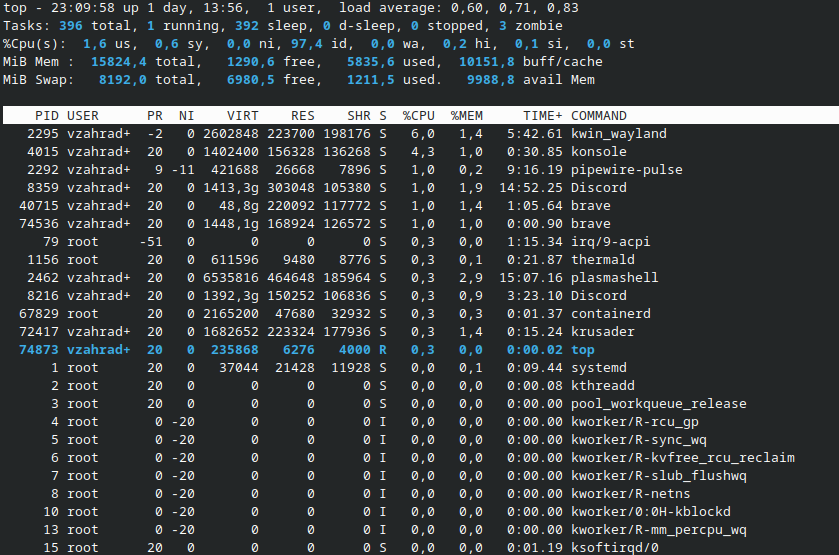
One domain receives additional attention.
The others remain active.
They simply run at lower intensity.
That is exactly what I am doing now.
For the next few months, tango receives more resources.
Languages continue.
Writing continues.
Exercise continues.
Business continues.
Everything stays alive.
Not equally.
But intentionally.
And most importantly, sustainably.
A Different Kind of Generalist
We live in a world optimized for specialists.
The education system rewards specialization.
Career advice rewards specialization.
Most productivity advice assumes specialization.
Sometimes for good reasons.
Specialists are easier to categorize.
Easier to market.
Easier to understand.
Generalists often appear scattered from the outside.
What people rarely see is the hidden advantage.
Generalists build bridges.
They transfer knowledge across domains.
They recognize patterns that specialists may never encounter because they remain inside a single field.
The tradeoff is real.
Progress in any one area may be slower.
But the resulting perspective is often wider.
Neither approach is superior.
They simply optimize for different outcomes.
Final Reflection
The most valuable lesson from this experiment was not about social skills.
It was not about tango.
It was not even about productivity.
It was about self-acceptance.
For years I occasionally tried to force myself into a specialist mold because it seemed more efficient.
Now I understand why those attempts never lasted.
I was fighting my own operating system.
If you are naturally wired for deep specialization, embrace it.
But if you repeatedly find yourself drawn toward multiple domains, perhaps the answer is not more discipline.
Perhaps the answer is better resource allocation.
Generalists do not necessarily need less curiosity.
They need a better scheduler.
And sometimes the most productive thing you can do is stop fighting the way your mind was designed to work.