Georges Méliès, Nikola Tesla, the McDonald brothers.
Different domains.
Different centuries.
Different kinds of genius.
And yet, they share a similar warning.
They created or shaped something revolutionary, but they were not the ones who captured the full economic value of it.
Méliès helped define cinema as fantasy and spectacle.
Tesla imagined and built systems that changed the technological world.
The McDonald brothers designed an efficient food-production pipeline that became the foundation for one of the most recognizable business empires on the planet.
But in all three cases, someone else became better at capture.
Someone else controlled the machinery around distribution, scaling, ownership, or monetization.
I will not go deeply into all three stories here. You can look them up at your own leisure.
Today, I want to stay with Méliès.
Because his story is not only about film.
It is about what happens when imagination creates value before its creator properly controls the path between creation and money.
Georges Méliès, the Creative Genius Who Ended Up Poor
Georges Méliès operated in the era when film was still discovering itself.
Many things taught in film schools today did not yet exist as established language.
They had to be invented.
Méliès was one of the people doing the inventing.
When others were still discovering what a camera could do, he dared to experiment.
He built a production studio.
He created hundreds of short films.
Different stories.
Different techniques.
Different illusions.
He did not treat the camera only as a device for recording reality.
He treated it as a machine for imagination.
That is why he matters.
Méliès was not merely documenting the world.
He was building worlds.
A Trip to the Moon
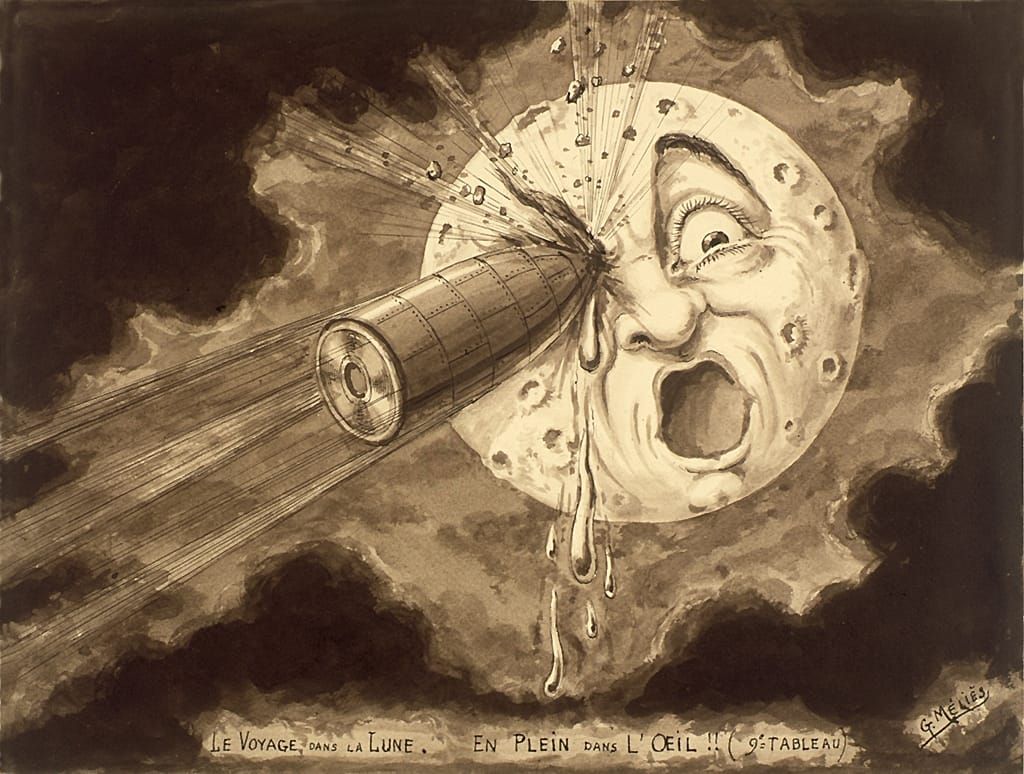
Then came Le Voyage dans la Lune.
A Trip to the Moon.
The film premiered in 1902.
The real Moon landing was still decades away. Even today, travelling to the Moon feels almost mythical to most people.
But Méliès did not wait for space technology.
He used imagination.
He created a story where people travel to the Moon in a giant capsule fired into space. Then he invented a fantasy world on the Moon itself.
Was it scientifically realistic?
Of course not.
That was not the point.
When you do not have data, imagination goes first.
The film became a technical marvel of its era.
A dream made visible.
A work of fantasy, craft, theatre, camera trickery, and production discipline.
A work of genius.
The Bootlegs
And this is where the story turns.
Méliès hoped to bring the film to the United States and benefit from its success.
He had something valuable in his hands.
But the early film industry was still messy.
Copyright, international distribution, intellectual property, and enforcement were not the mature systems we know today.
A Trip to the Moon was widely pirated in the United States.
Copies circulated without Méliès properly benefiting from them. Edison’s distribution ecosystem is often mentioned in connection with these unauthorized copies, but the broader point is not one single villain.
The broader point is the structure.
The film travelled.
The money travelled.
But not enough of it travelled back to Méliès.
From what I could tell, he did not merely lose revenue.
He also lost authorship in many screenings.
Audiences saw the magic.
Others captured the commercial value.
The creator of the Moon dream did not become the one who profited most from bringing that dream to the market.
He eventually ended up poor and largely forgotten for a time.
Nikola Tesla’s story rhymes with this in another domain.
Not literally in every detail.
But structurally.
The unusual mind opens a door.
Someone else builds the machinery to charge admission.
What Can We Learn From This?
If you are lucky enough to have an unusual mind, that is not enough.
Even if you create something original, useful, beautiful, or revolutionary, that alone does not guarantee safety.
It does not guarantee wealth.
It does not guarantee recognition.
It does not even guarantee that people will remember who made the thing.
That is the uncomfortable lesson.
Creators often love creation more than protection.
Artists want to make art.
Inventors want to invent.
Engineers want to build.
Founders want to bring something new into the world.
That is the beautiful part.
But it is also the Achilles heel.
The creator may care deeply about craft, research, imagination, and quality, while ignoring the boring machinery around the work:
- rights,
- contracts,
- distribution,
- backups,
- ownership,
- trademarks,
- publishing infrastructure,
- archives,
- financial capture,
- control over the relationship with the audience.
And sometimes that boring machinery decides the whole story.
Not because the work is unimportant.
Because the work needs a vessel.
A masterpiece without protection can become raw material for someone else’s business model.
Creation Is Not Enough
This is not a call to become cynical.
It is not a call to stop creating.
It is not a call to assume everyone is waiting to steal from you.
But it is a call to respect the full architecture of value.
Creation is only one layer.
The second layer is protection.
The third layer is distribution.
The fourth layer is capture.
If you ignore those layers, you may still create something important.
But you may not be the person who benefits from it.
That is the warning in Méliès.
That is the warning in Tesla.
That is the warning in many stories where someone invents, designs, or builds something powerful, and another person or institution becomes better at scaling it, owning it, or monetizing it.
My Personal Translation
For me, this confirms a direction I have already taken.
In the past year, I have spent a lot of time thinking about how to protect my work.
Not only legally.
Operationally.
I think about backups.
Multiple locations.
Git archives.
Paper copies of important documents.
Ownership of publishing infrastructure.
Control over my website.
Distribution that does not depend entirely on social platforms.
Assets that do not disappear because one account gets locked or one device gets stolen.
I also spent time and money protecting names and marks that matter to me, including filing a trademark application with EUIPO.
Some of this may sound excessive from the outside.
But history is full of people who created first and protected later.
Sometimes later never came.
The Pattern
The story of Méliès is not isolated.
It is a pattern.
The person who creates value is not always the person who captures value.
The person who opens the door is not always the person who owns the building.
The person who imagines the Moon is not always the person selling tickets to the journey.
That is why protection matters.
Not because creation should become secondary.
But because creation deserves a structure strong enough to survive contact with the world.
Conclusion
Méliès built the Moon.
Others sold the copies.
The lesson is not bitterness.
The lesson is architecture.
Do not only create.
Protect the path between creation and value.
The full Le Voyage dans la Lune — the work that made Méliès’ imagination travel further than his rights protection could follow.