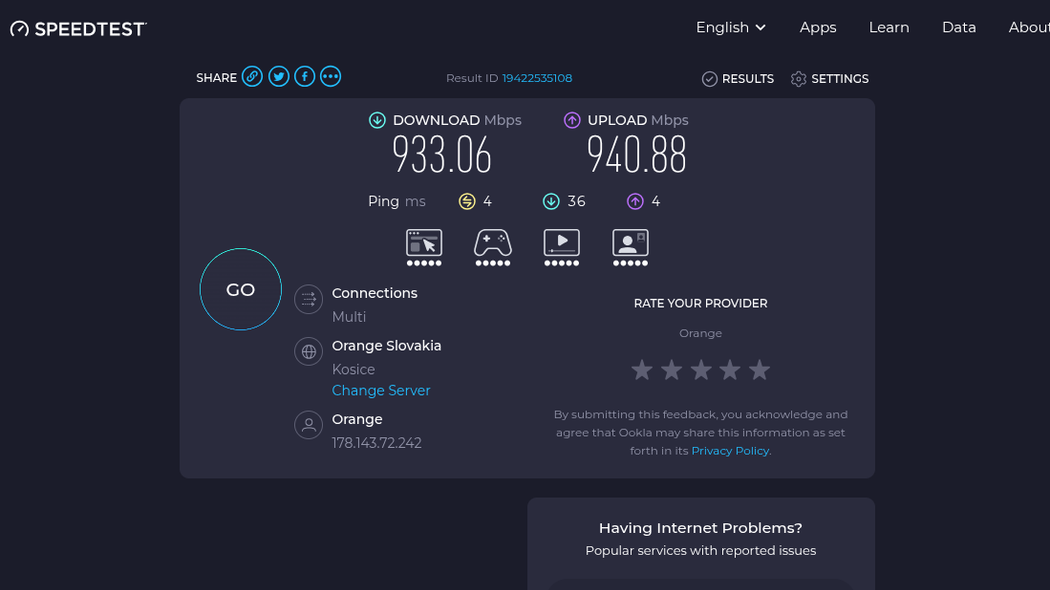
My telco operator recently introduced a new fiber optics program delivering up to 2.5 Gbps download / 1 Gbps upload.
This is the second-largest ISP in my country, and the service is supposed to reach roughly two thirds of households. I hope this creates pressure for the rest of the market, because competition in infrastructure is one of the few forms of pressure customers can actually feel.
But this is not an article about my local ISP market.
This is about something else.
I upgraded my home internet to a speed my internal network cannot fully use yet.
And I still think it was the right decision.
My home network is now the bottleneck
My router is not a normal consumer router.
It is a Lenovo mini PC running as my own router. It uses a 2.5 GbE USB adapter, and since USB 3 gives us a generous 5 Gbps theoretical ceiling, the router itself should be capable enough for this internet tier.
When I was pulling Ethernet wiring through my home, I used Cat7 cables. So even the wiring is future-proof for a while. Maybe beyond 10 Gbps, depending on distance, termination quality, and how brave I feel when testing it later.
The current bottleneck is my switch.
In theory, I could play with SFP+ modules and create a 2.5 Gbps uplink toward the router. But this would not change the topology much. The regular ports are still 1 Gbps, so most devices would remain limited anyway.
I could selectively upgrade the path to my NAS and other strategic equipment, but that would complicate the network for a relatively small practical gain.
So I decided to wait.
And yet I still upgraded to the fastest fiber program available.
Why?
2.5 GbE is in an awkward phase
In private households, 2.5 Gb Ethernet is slowly becoming normal, mostly because of Wi-Fi 6 and newer routers.
But when you try to buy a switch that handles this properly, the market is still awkward.
You can find small dumb 2.5 GbE switches with a few ports. You can also find serious business-tier switches with 10 GbE ports, SFP+, management features, PoE, and a price that suggests you are building a small office or lab, not upgrading a home network.
The middle is strangely thin.
I do not want a random plastic box with five ports.
I also do not need an overpowered enterprise switch just to make my apartment feel slightly more symmetrical.
So for now, the internal network stays partly behind the internet connection. This sounds irrational until you remember that download speed is only part of the story.
Upload matters more than people think
The new program gives me 1 Gbps upload.
For many households, this may still sound absurd. Most people do not need it. They stream video, browse the web, work remotely, sync phones, maybe back up photos. Their bottleneck is rarely sustained upstream bandwidth.
My situation is different.
I genuinely move large amounts of data between two sites. This is not even company data. My home NAS has a backup at a remote location, at my parents’ place, and I send BTRFS snapshots over fiber.
When you move hundreds of gigabytes, upload speed stops being a marketing number.
It becomes time.
It becomes comfort.
It becomes whether your backup strategy feels natural enough that you keep doing it.
The Sunday afternoon migration
I had been considering the switch for a while, but I could not afford a random outage. I need the internet for work, and not only I use the connection.
So yesterday, on Sunday, the timing looked perfect.
Rainy day. No major commitments. A good day to spend on infrastructure maintenance.
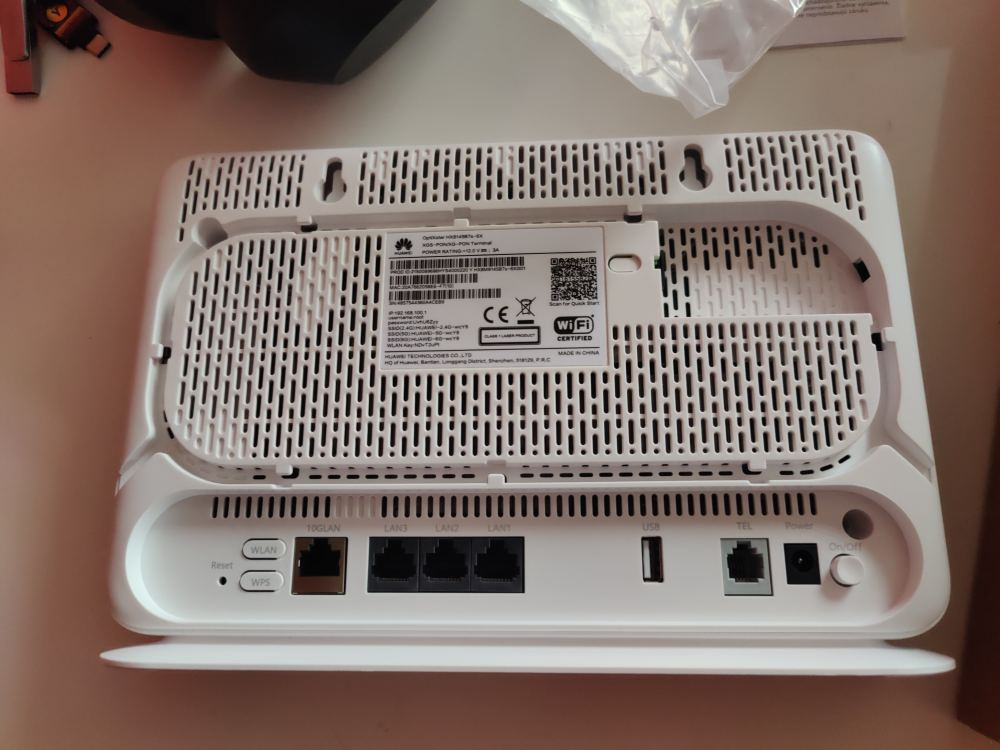
When I came to the telco center, I already had most technical details in my head. I knew they were using a newer fiber standard, XGS-PON. I knew I would probably need a new optical network terminal or fiber converter. My questions were mostly pragmatic.
Does the new device still support bridge mode?
Can I keep my public IPv4 address?
Can I finally activate a static IP?
That last one matters more than it sounds. Losing VPN access while abroad because my home IP changed is much less fun than paying a few extra euros per month for the comfort of having the same IP for years.
The migration itself was smooth. I had to wait for the new device to be provisioned by the operator. After that, it was mostly testing on my side and updating my network configuration.
Nothing dramatic.
Which is exactly what you want from infrastructure work.
The unexpected upside: stability
After running speed tests repeatedly, I noticed something interesting.
The connection was not only fast. It was very stable.
No meaningful fluctuation.
That was unexpected enough that I started digging deeper. I wanted to understand what might be happening.
The majority of customers still run on GPON. I had been migrated to XGS-PON.
XGS-PON supports up to 10 Gbps symmetric at the standard level, but that alone does not explain the feeling of stability. The more interesting part is that GPON and XGS-PON are not simply the same pool with a faster label. They use different wavelengths and can coexist on the same fiber infrastructure.
In simple terms, many people may still be chatting in the old crowded room, while I moved into a newer room that is technically shared, but probably much less populated.
The exact local contention ratio is not something I can verify from outside the operator’s network. I do not know how many people in my town are already on this tier.
But operationally, it feels like I moved into a much lighter pool.
Everyone else is still mostly on GPON wavelengths. My service is on XGS-PON.
This is still not a leased line. There is no SLA, no guaranteed repair time, no contractual promise that I have the capacity to myself.
But while adoption is low, it can feel unusually close to a cheap pseudo-leased-line experience.
For around the price of a consumer connection.
That is the interesting part.
The early-adopter infrastructure advantage
Most people do not need XGS-PON yet.
Their current internet is good enough.
GPON handles ordinary household life perfectly well: streaming, phones, laptops, smart TVs, normal remote work, browser tabs, cloud sync, all the usual modern rituals.
So most people stay where they are.
A few early adopters move into the newer layer.
The newer layer has much more capacity.
Adoption is still low.
The result may be a disproportionate practical advantage for the early mover.
This is not magic. It is not private infrastructure. It is still shared.
But shared infrastructure does not always behave the same. A crowded shared pool and an almost empty shared pool are both shared, but they are not the same lived experience.
That is the pattern I find more interesting than the speed test screenshot.
What does this mean for business infrastructure?
As a business, you have several broad options when it comes to your data and internal systems.
You can store everything in the cloud and delegate most operational responsibility to someone else.
You can build your own infrastructure and place your servers in a commercial datacenter through server housing or colocation.
Or, increasingly, there may be a third option for some technical founders and small companies:
build a private micro-datacenter using commercially available fiber.
Not for everyone.
Not for every workload.
Not as a replacement for proper datacenters, cloud platforms, or CDNs.
But for some use cases, this starts becoming realistic.
Especially if your needs include storage, private services, internal tooling, backups, development environments, media processing, archives, AI experimentation, or controlled origin infrastructure.
The internet connection is no longer automatically the weakest link.
That changes the equation.
A micro-datacenter is not just racks
Of course, a datacenter is not just PCs in racks.
Even a micro-datacenter needs serious thinking.
Cooling matters.
Power matters.
UPS matters.
Fire risk matters.
Dust matters.
Monitoring matters.
Network segmentation matters.
Backups matter.
Offsite replication matters.
Physical access matters.
Recovery procedures matter.
Redundant connectivity matters, ideally from two independent ISPs.
The problems are smaller than the problems faced by hyperscalers like Google or Amazon, but they do not disappear. They simply become scaled to one owner’s needs instead of millions of users.
I have seen small private datacenter rooms before. When I was working at Alcatel-Lucent, this was not an exotic fantasy. It was infrastructure. Racks, cabling, cooling, power, monitoring, access control.
Not trivial.
But imaginable.
And the idea of owning my infrastructure and having it under my own roof is too tempting to ignore.
Dedicated AI racks. Storage racks. Backup targets at a different location. Private cloud services. Internal command infrastructure. Media encoding. Development environments that are physically mine.
This is no longer science fiction for a small technical operation.
It may soon become a rational option.
Fiber has a strange future-proof quality
There is also a deeper reason I care about fiber.
The physical medium is unusually powerful.
One of my university professors used to say that fiber is almost limitless in capacity from the practical perspective of access networks. The glass in the ground can remain the same, while the devices at the ends change and the capacity jumps by orders of magnitude.
That sentence stayed with me.
We already see this pattern.
GPON.
XGS-PON.
NG-PON2.
Future standards.
Different wavelengths. Better optics. Better electronics. Better multiplexing. More capacity over the same physical path.
NG-PON2, for example, can reach serious multi-10-gigabit symmetric capacity at the standard level. Whether and when consumer or small-business operators deploy such services widely is a different question. But the direction is clear.
The interesting lesson is not that I personally need 40 Gbps at home today.
I do not.
The lesson is that a fiber connection is not like many other consumer technologies. It can become dramatically more capable when the operator changes the active equipment and service tier.
The cable in the wall may outlive multiple generations of network equipment.
That makes early positioning on the newer optical layer strategically interesting.
What about scale and high availability?
If I decided to operate my own streaming platform, this home connection would obviously not be enough for public-scale delivery.
Certainly not for hundreds or thousands of concurrent users streaming content.
And that is fine.
Because that problem has already been solved commercially by Content Delivery Networks.
I am not trying to replace the caching layer of the internet.
I do not want to build a global CDN from my home.
I am not that delusional. At least not this decade.
The better architecture is simpler:
own the origin, rent the edge.
My private infrastructure can store masters, metadata, packaging rules, access logic, archives, and internal systems.
The CDN can serve replaceable copies at global scale.
The private site does not need to deliver every video stream to every viewer directly. It needs to feed the distribution layer with properly packaged content.
The CDN handles geography, caching, burst traffic, public delivery, and bandwidth spikes.
That is the division of labor I like.
I keep the core.
I rent the edge.
CDN-compatible, not CDN-dependent
This distinction matters.
I am not against external infrastructure. That would be childish. CDNs exist because global distribution is hard, expensive, and operationally complex.
Renting that layer is acceptable.
Even desirable.
But the architecture should remain CDN-compatible, not CDN-dependent.
The CDN should receive deliverable artifacts:
packaged media, manifests, fragments, encrypted segments, cacheable files, public distribution objects.
But the core should remain elsewhere.
The masters should remain under my control.
Metadata should remain under my control.
Identity should remain under my control.
Keys and access logic should remain under my control.
The CDN should be replaceable in principle, even if replacing it in practice is never completely free.
That is the architecture I want.
Not cloud rejection.
Not homelab romanticism.
A sober division of responsibility.
Why I really migrated
All these business and infrastructure implications are useful.
They may even influence how I plan my future systems.
But they were not the original reason I upgraded.
The real reason was simpler.
I am an early adopter.
That is it.
I did not care about the throughput first. I cared about the technology.
XGS-PON was finally available to me. A new optical layer. A new device. A new service tier. A new set of constraints and possibilities.
I wanted to touch it.
I wanted to see how it behaves.
I wanted the physical infrastructure in my home to move one step further into the future, even if my switch is not ready yet.
Now I can experiment. I can slowly migrate the internal network. I can upgrade equipment when the market makes more sense. I can observe stability over time. I can test backup workflows, VPN access, remote services, and maybe eventually more serious origin infrastructure.
The insight about using commercial fiber as part of a private business infrastructure strategy was unexpected.
But it is worth taking seriously.
The actual lesson
I upgraded my internet beyond what my equipment can currently handle.
On paper, that sounds irrational.
In practice, it gave me something more important than immediate full throughput.
It moved my home into a newer infrastructure layer.
It gave me much stronger upload.
It gave me a static IP.
It made my internal network the bottleneck, which is a good problem to have.
It revealed how lightly used future layers can create an early-adopter advantage.
And it made the private micro-datacenter model feel less like a fantasy and more like an architectural option.
Not for everything.
Not without risk.
Not without power, cooling, backup, monitoring, redundancy, and recovery planning.
But real enough to matter.
The clean principle is this:
Own the core. Rent the edge.
Keep the origin, data, masters, metadata, keys, packaging logic, and architecture under your control.
Use external infrastructure where it actually helps: distribution, burst capacity, geographic reach, caching, and public scale.
That is not nostalgia for the old internet.
It is not cloud maximalism either.
It is infrastructure optionality.
And sometimes optionality starts with a rainy Sunday, a new fiber converter, and an internet connection faster than your switch can handle.