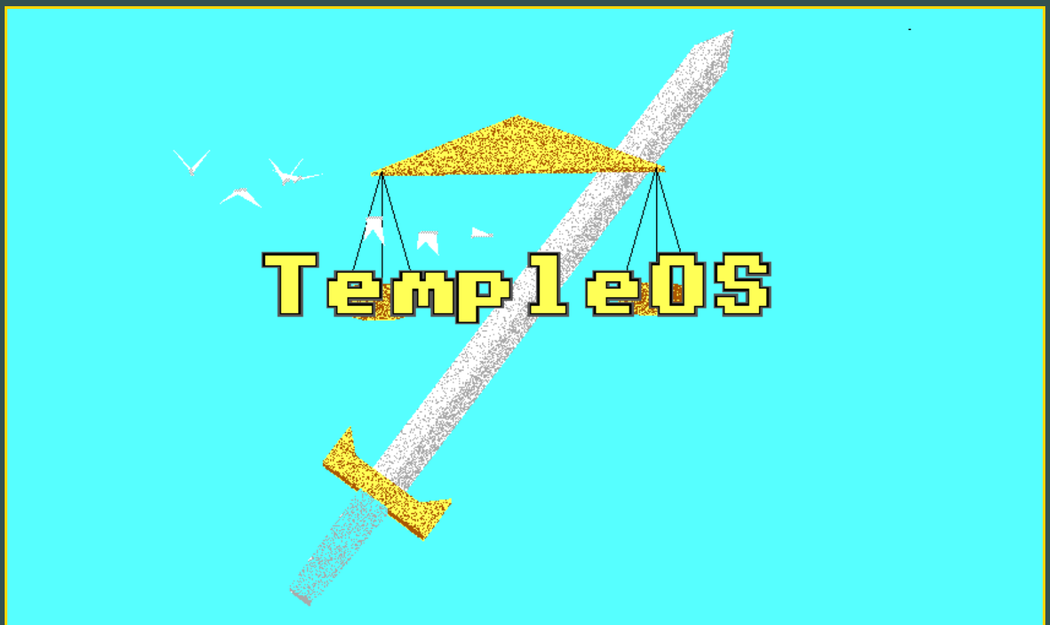
Months ago, I discovered a Linus Tech Tips video about TempleOS.
It was presented as an eccentric and unusual work of one man: Terry Davis.
Terry suffered from schizophrenia. He believed he had been given a divine intellect and that, as the best programmer in the world, he was supposed to create the second Temple of Solomon. Hence the name: TempleOS.
He created his own programming language, HolyC.
He created his own filesystem.
He created a bootloader, a kernel, graphics libraries, a display system, a shell, documentation, and games running inside his own system.
We can argue about the usefulness of this work.
But I do not think it is hard to say that TempleOS was a work of art.
Not art in the decorative sense.
Art as a complete sovereign artifact.
A world built by one mind.
Digging deeper
Most people would probably watch the popular video and stop there.
Not me.
Somehow I ended up watching Terry’s old livestreams.
And I learned a lot from him.
His way of speaking was unconventional. Sometimes difficult to follow. Sometimes painful to watch, because his illness was not an abstract footnote. It was present.
But many of his technical principles still hold.
One line in particular stayed with me:
An idiot admires complexity while a genius admires simplicity.
TempleOS demonstrates this principle almost everywhere.
A consumer operating system can have far simpler requirements than something designed to run servers, clusters, containers, databases, browsers, graphics cards, networking stacks, security models, enterprise policies, and decades of compatibility layers.
Terry used a different analogy.
He said he was building a motorcycle while Windows was a car.
A motorcycle is easier to build.
Also easier to crash.
That is the tradeoff.
TempleOS was not trying to be Windows, Linux, macOS, Android, or a general-purpose modern operating system.
It was a deliberately constrained world.
If something could be written simply, Terry tried to write it simply.
He was not afraid to break patterns.
No virtual memory.
No conventional separation between processes.
No complex security model.
No networking.
No “let us satisfy every possible use case because someone on the internet will complain.”
He kept saying TempleOS was designed to run one game well, while Linux was designed to run two games well.
That sounds absurd until you understand the point.
He was mocking the assumption that all complexity is automatically progress.
One of Terry Davis’ own recordings. His delivery could be difficult to follow, but the technical principle underneath is worth listening for: simplicity was not an aesthetic preference, but a design law.
The pattern
Most people do not know Terry Davis.
If they randomly encountered him online, many would probably not understand what he created.
But nobody serious can deny that he was a brilliant programmer.
The world is full of brilliant programmers, though.
So where did Terry differ?
He did not merely learn the existing architecture of operating systems and contribute to some established stack.
He challenged the entire shape of the thing.
Most programmers learn abstractions, layers, conventions, best practices, security assumptions, scheduler models, filesystem conventions, user-space and kernel-space boundaries, and all the inherited structure of computing.
Then they work inside that structure.
Terry did something different.
He built his own structure.
We may disagree with many of his decisions. We may consider some of them unusable for production. We may say the system was deliberately limited, unsafe, impractical, and almost impossible to adopt outside its own world.
All of that can be true.
And still, TempleOS has value.
Why do we build proofs of concept before building products?
Because we want to experiment.
We want to try strange approaches.
We want to evaluate possibilities before freezing them into production architecture.
We want to play with the solution space before the market, security team, enterprise customer, compliance layer, and support burden arrive.
In that sense, I see TempleOS as a trove of experimental concepts.
Not something to copy blindly.
Something to inspect.
Carefully.
Maybe some ideas remain art.
Maybe some ideas remain warnings.
Maybe some ideas belong only inside TempleOS.
But maybe some concepts could reappear later in specialized environments, embedded systems, educational tools, creative computing, restricted devices, or deliberately simple local software.
That is the value of a world like this.
It shows that reality could have been arranged differently.
A complete world in code
Terry Davis built his own world.
He built it in code because code was his home.
But it was still a complete working home.
It had its own language.
Its own rules.
Its own jokes.
Its own constraints.
Its own graphics.
Its own games.
Its own religious frame.
Its own standards of beauty.
Its own idea of simplicity.
Its own refusal of what the outside world considered necessary.
No networking was not a missing feature in the usual sense.
It was part of the world.
TempleOS was not a failed attempt to become a mainstream operating system.
It was a sovereign technical universe with its own laws.
That is why I find it hard to treat it merely as “software.”
It is closer to world-building.
And this is where the connection becomes interesting.
Terry Davis, Tolkien, and Sapkowski
What Terry Davis built is not that different in structure from what J.R.R. Tolkien or Andrzej Sapkowski built.
The medium is different.
The mental state is different.
The cultural reception is different.
The commercial history is different.
But the underlying pattern is familiar:
one person creates a world with its own rules, language, history, constraints, atmosphere, and internal coherence.
Tolkien did not merely write a story about a hobbit on a mission to destroy a ring.
He built a world.
Languages.
Scripts.
Poetry.
Genealogies.
Ancient histories.
Wars.
Geography.
Cosmology.
Races.
Cultures.
A deep sense that the story we see is only the visible tip of a much older world.
Middle-earth feels alive because the story does not feel like the whole thing.
It feels like an opening into something larger.
That is why the world survived the books.
A derivative musical interpretation of Tolkien’s world. When a world is strong enough, even its songs and fragments become new entry points.
And even with Tolkien, the world exceeded what was fully exposed during his lifetime. The works most people associate with Middle-earth were published while he was alive, especially The Hobbit and The Lord of the Rings. But much of the deeper legendarium was assembled and published after his death by Christopher Tolkien.
In a strange way, Christopher became almost like a maintainer of a massive repository.
He did not create the original world.
But he helped expose, organize, and publish more of the underlying system.
Sapkowski is similar in another way.
He created the world of The Witcher.
The books already had value. They were not nothing. They were known, especially in Poland and Central/Eastern Europe.
But the world became much larger in global perception after CD Projekt built an interactive implementation of it.
The Witcher did not become global only through the original books. Games, music, adaptations, and derivative works created many new handles into the same world.
The games did not create the Witcher universe.
But they created a scalable interface into it.
They gave millions of people a way to enter.
That distinction matters.
The world existed before.
The product surface expanded later.
Creating value and capturing value are different skills
This is the lesson.
Creating value and capturing value are two different skills.
Terry Davis created an extraordinary technical world.
Tolkien created one of the strongest literary worlds of the twentieth century.
Sapkowski created a world that later became a major game and media franchise.
But creating a world is not the same as packaging that world into a product people can access, understand, buy, recommend, repeat, and build around.
Sometimes others do that part.
Sometimes they do it after the creator dies.
Sometimes they do it through games.
Sometimes through films.
Sometimes through theme parks.
Sometimes through merchandise.
Sometimes through institutions.
Sometimes through documentation, licensing, translation, distribution, or community.
But the pattern is always the same:
the world is not enough.
The world needs a handle.
Without a handle, value remains trapped inside the creator’s universe.
Visible to the creator.
Maybe visible to a few obsessives.
But not accessible to the outside world.
The counterexamples: Disney and Lucas
There are also counterexamples.
Walt Disney and George Lucas did not merely create worlds.
They also built containment systems around those worlds.
Disney did not stop at characters and films.
He built a studio, distribution machine, brand machine, merchandising machine, and eventually Disneyland.
He turned imagination into an institution people could physically enter.
That is value containment.
Disneyland opening day: imagination becoming infrastructure, broadcast, crowd management, physical access, and an institution people could enter.
George Lucas created Star Wars, but he also understood toys, licensing, effects infrastructure, mythology, visual identity, sound design, merchandising, and repeatable world access.
Star Wars became so culturally large that people who barely knew science fiction still knew the name.
Sometimes they even confused it with Star Trek.
That confusion is funny, but it also proves the point.
The impact became so large that even people outside the domain had to carry some representation of it in their heads.
That is not only creation.
That is capture.
That is containment.
That is a world with handles everywhere.
Films.
Toys.
Games.
Books.
Logos.
Music.
Quotes.
Characters.
Costumes.
Memes.
Theme-park experiences.
The world became accessible from many directions.
The world is not the product
This is where many creators fail.
They think the world is the product.
It is not.
The world is the source.
The product is the handle.
A book can be a handle.
A film can be a handle.
A game can be a handle.
A workshop can be a handle.
A consulting offer can be a handle.
A public talk can be a handle.
A technical tool can be a handle.
A community can be a handle.
A job title can even be a handle, although usually a crude one.
The outside world does not know how to consume your entire universe.
It needs an entry point.
It needs something small enough to understand, specific enough to buy, and clear enough to recommend.
This is especially painful for generalists.
A specialist has a simple handle.
Android developer.
Security engineer.
DevOps consultant.
Tango teacher.
Copywriter.
Product designer.
A generalist may have more internal value, but less external legibility.
The world cannot buy “everything I can see.”
It can only buy what it can name.
My own lesson
In the past few years, I have been building my own world.
Not only one project.
A world.
Technical architecture.
Writing.
Founder systems.
Hiring filters.
Infrastructure philosophy.
Embodiment.
Tango.
Language learning.
Public speaking.
Storytelling.
Private cloud.
Documentation tooling.
A future media layer.
A company myth.
A structure behind the visible structure.
I have been sharing glimpses of it publicly, but mostly the underlying architecture.
If I use Tolkien as an analogy, I have been sharing the physics of my world before sharing the stories on top.
The laws.
The operating principles.
The metaphors.
The constraints.
The way I think reality should be arranged.
But the outside world does not automatically know what to do with that.
With eyes open, the world tells you what it wants.
These past few days, I have been going through open jobs across Europe, and the message is clear:
right now, the market wants deep specialists.
It wants named functions.
It wants someone who fits into a box that already exists.
Android.
Backend.
DevOps.
AI engineer.
Security.
Cloud.
Platform.
Data.
It does not know how to use a generalist like me unless I give it a handle.
I could say the market is stupid.
Sometimes I am tempted.
But that would be too easy.
The harder truth is this:
if the world cannot use the value I created, the packaging is still my problem.
That is value containment.
The outside world does not care how much value exists inside your world.
It asks:
Where is the door?
Handles are not betrayals
This is the part that matters.
Creating a handle does not mean betraying the world.
It does not mean reducing the work to something shallow.
It does not mean becoming a generic consultant, generic developer, generic coach, generic creator, or generic anything.
A handle is not the whole world.
It is the first usable interface.
That is why I wrote What I Can Actually Help With.
That article does not contain the whole world.
It is not supposed to.
It gives the outside world a way to understand where I can be useful:
technical architecture, founder systems, documentation, tooling, AI-assisted delivery, infrastructure, leadership, narrative structure.
It is not the mythology.
It is not the full operating system.
It is a handle.
And right now, I need handles.
Not because the world behind them is fake.
Because the world behind them is too large to be consumed at once.
Terry never built the handle
Terry Davis created TempleOS.
He built a world in code.
But he never built the handle that would allow the outside world to use it.
Maybe he could not.
Maybe he did not want to.
Maybe the world was never meant to be productized.
Maybe productizing it would have destroyed part of what made it pure.
That is possible.
Not every world must become a product.
But if the creator wants the world to survive outside himself, the handle matters.
Tolkien had books.
Sapkowski had books, and later games.
Disney had films, characters, parks, licensing, institutions.
Lucas had films, toys, effects technology, mythology, and distribution.
Terry had TempleOS itself, scattered videos, livestreams, and later other people explaining him to the public.
That is a much weaker handle.
The value existed.
The capture was fragile.
The final principle
A world can be brilliant and still commercially invisible.
A system can be profound and still unusable from the outside.
A creator can build something extraordinary and still fail to give people a doorway into it.
That is the painful distinction:
creating value is not the same as capturing value.
And capturing value is not only about money.
It is about access.
Transmission.
Packaging.
Memory.
Interface.
Legibility.
Repeatability.
The outside world does not buy the whole universe.
It buys the first usable doorway.
That is the work I am learning now.
Not only how to create the world.
But how to build the handle.