Today I want to talk about sovereignty from yet another angle.
In the past months, I have touched this topic many times.
I wrote about auditable Git repositories. I wrote about the Apollo-era NASA model, where the central architect delegates parts of the work to contractors while still keeping control through specs, constraints, documentation, validation, and integration.
This time, I want to apply the same thinking to a much more mundane domain:
car and motorcycle maintenance.
Because sovereignty is not only about nations, servers, clouds, platforms, cryptography, or institutions.
Sometimes sovereignty starts with knowing what was done to your Mazda.
The problem: convenience over sovereignty
Many people treat vehicle maintenance as something that only becomes real when a warning appears on the dashboard.
And even then, some warning lights are ignored for a while because the car still drives, money is tight, or the owner simply does not want to deal with it.
I understand the temptation.
Vehicle maintenance is often invisible.
You take the car to a repair shop. You pay. They do some work. You pick it up. In many cases, the car feels almost the same as before.
This does not mean the money was wasted.
Quite the opposite.
Stability is often boring and invisible.
An oil change is invisible.
HVAC maintenance is invisible.
Filter replacement is invisible.
A software update may be invisible.
Proper diagnostics may also be invisible until the report shows you something that would otherwise stay hidden.
The last time I paid for thorough diagnostics on my Mazda, the report revealed the need to replace fuel injectors and do deeper engine maintenance. Under normal operation, these issues were not obvious. The car still drove. Nothing dramatic happened.
But the machine had a state.
And that state mattered.
If I had ignored it, invisible degradation could have turned into a visible problem later.
This is the first mental shift:
A machine can feel fine and still need maintenance.
The black-box repair model
Most people treat repair shops like any other service provider.
I own the car.
Something is broken.
I call a number.
I get an appointment.
I drive the car there.
I pick it up later.
I pay.
Done.
For many people, this is good enough.
But it has a cost.
If you rely entirely on repair shops and treat your own vehicle as a black box, you lose sovereignty immediately.
The trade-off is convenience.
And convenience works beautifully until it suddenly does not.
What happens when the authorized repair shop tells you the next appointment is in a month?
What happens if the only available shop is in another city?
What happens if you need to use an unauthorized shop and you do not know whether they are good enough?
What happens if one shop does brakes, another shop does diagnostics, another shop changes tires, another shop handles bodywork, and the full service history becomes scattered across invoices, emails, SMS messages, and vague memory?
Most importantly:
what happens if you cannot tell the difference between work that was needed, work that was done, work that was skipped, and work that was done badly?
That is the real sovereignty problem.
Not whether you can personally replace every part.
But whether you know the state of the machine you own.
Aviation understands the paper trail
In aviation, an aircraft without thorough maintenance documentation can become almost worthless.
Safety is not guaranteed by good intentions.
It is guaranteed through logs, inspections, audits, reports, procedures, signatures, service intervals, traceability, and records.
Thousands of pages may exist to show what was done, when it was done, who did it, what parts were used, which inspections were performed, and what the aircraft’s state is.
This is not paranoia.
It saves lives.
A plane without records has an unknown state.
And in aviation, unknown state is dangerous.
Aircraft ownership makes the principle obvious: the paperwork is not separate from the machine. It is part of knowing the machine’s state.
Of course, I do not need aircraft-level paperwork for a Mazda or a Yamaha.
But the principle scales down beautifully:
If you want to own the machine properly, own the records.
A car or motorcycle without a service history is not fully known.
It may be legally yours.
But operationally, part of it is still hidden from you.
Back to the NASA analogy
The Apollo-era NASA analogy is useful here.
NASA hired countless contractors because the Apollo program needed them.
But NASA did not simply say:
Build us a rocket.
NASA specified what it wanted.
Constraints.
Interfaces.
Materials.
Tolerances.
Tests.
Reports.
Procedures.
Validation.
Contractors did parts of the work, but NASA retained the system view.
That is how I want my relationship with repair shops to work.
A repair shop is a contractor.
Sometimes I will use an authorized repair shop.
Sometimes I may use an independent specialist.
Sometimes I may do simple work myself.
Sometimes I may ask for diagnostics only.
Sometimes I may ask someone else to do a specific job because I am busy, not because I am helpless.
But in all cases, I want to keep the system view.
Every contractor knows only what I tell them.
If I do not know the history, I cannot brief them properly.
If I cannot brief them properly, I lose control.
From black box to white box
The moment you take ownership, the relationship with the machine changes.
The car stops being someone else’s problem.
The motorcycle stops being just a thing that either starts or does not start.
It becomes a system with state, history, weaknesses, intervals, known repairs, open questions, and future work.
You stop asking only:
Is it broken?
You start asking:
What is its current state?
What has been done?
What has not been done?
What is due soon?
What should be monitored?
What changed after the last service?
Which issue appeared after which intervention?
And because no normal person can remember all of this reliably, you need a system.
A digital service history in Git
My regular readers know I like Git for holding even private knowledge.
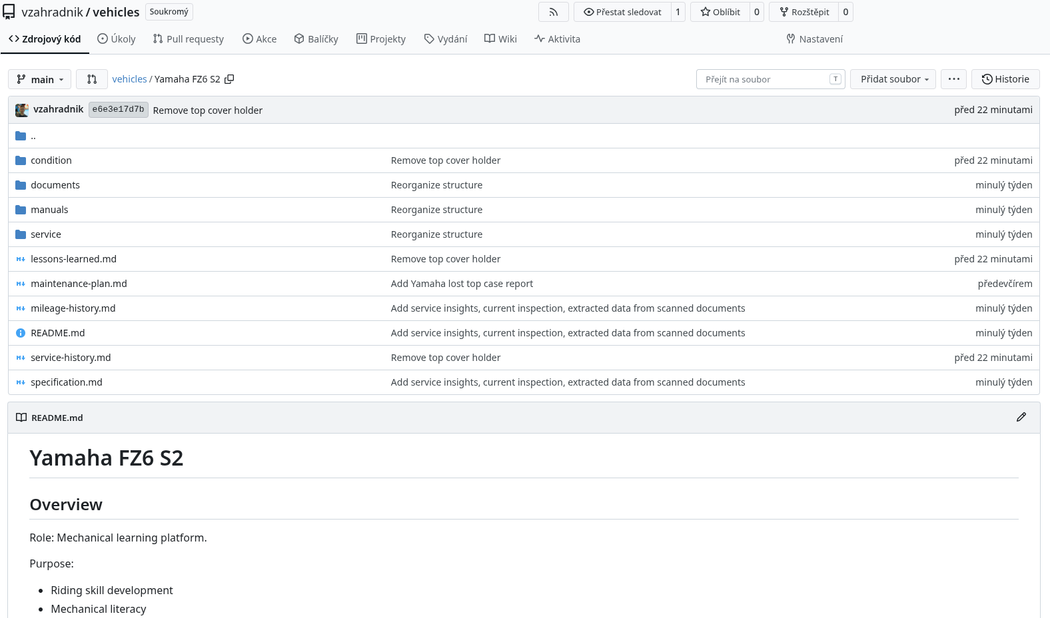
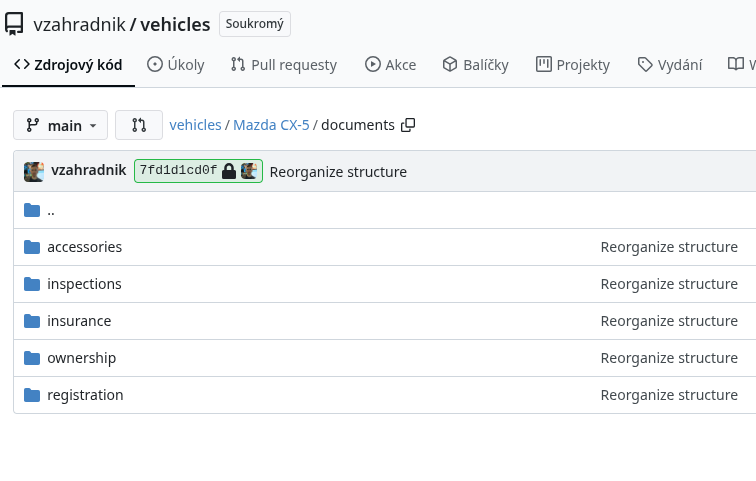
So it should not be surprising that I created a private repository called vehicles.
Not on GitHub.
Not public.
Not somewhere I casually leak invoices, IDs, insurance papers, or machine history.
It lives on my own private Gitea server, under my control.
This matters.
A vehicle repository can contain sensitive data. Technical certificates, insurance documents, invoices, photos, odometer readings, VIN-related documents, and identity documents should not be thrown into a random public or semi-public place.
The point is not to make the service history public.
The point is to make it auditable, searchable, structured, backed up, and owned.
Creating the repository took me a couple of days, but it was worth it.
I scanned relevant invoices and documents showing what was done to the car, when, why, and how much it cost.
I scanned technical documents, insurance papers, and other vehicle-related records.
I included timestamped photos capturing the current state of the vehicles.
I keep adding new photos during incidents, checks, and changes.
For example, I take photos of the odometer as evidence of mileage at a given moment.
I downloaded official user manuals and service manuals where available.
I categorized all of this for easier access.
Then I used an LLM to help create Markdown summaries from the source material.
The LLM is not the source of truth.
The source of truth remains the invoices, documents, photos, manuals, and my own verification.
But the LLM helped merge the scattered service history into readable documents.
That is the useful part.
For the first time, I could tell with much higher confidence what had been done to my car across several independent sources.
Not from memory.
Not from vibes.
From records.
Records are not only for maintenance
Auditability is not only about scheduled maintenance.
It is also about incidents.
Coincidentally, today I was riding my motorcycle.
It was a short trip, maybe fifteen kilometers. Part of it was on a highway. I experienced nothing unusual while riding.
Then I stepped off the motorcycle at the destination and noticed that my rear top case was gone.
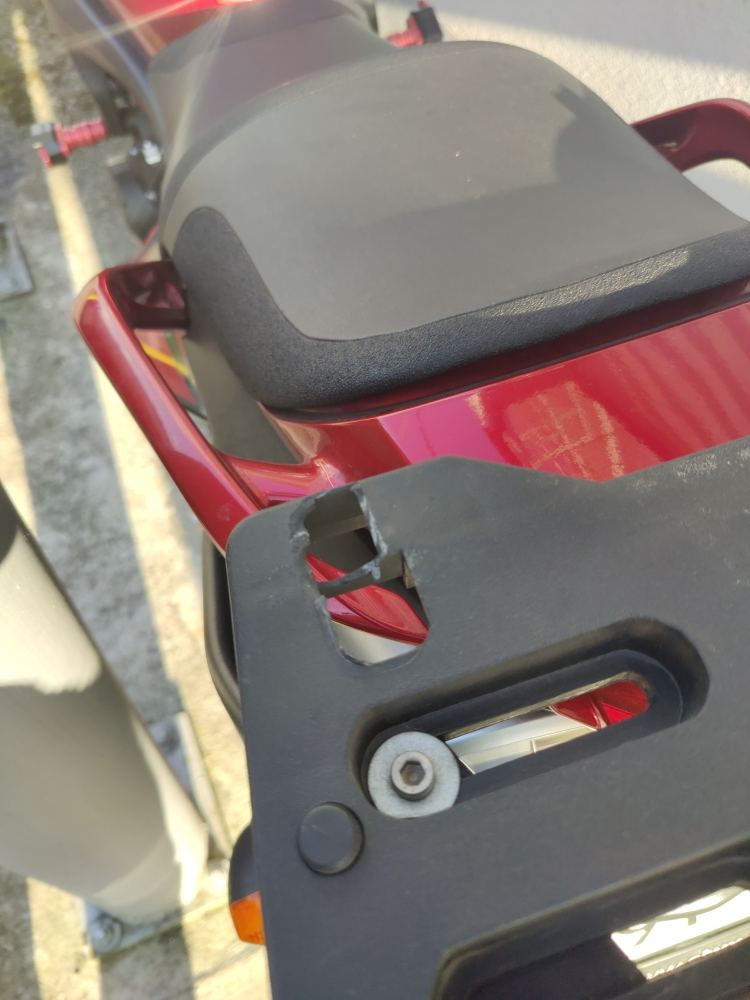
The holder had snapped, and the trunk disappeared somewhere during the ride.
I am glad nobody was hurt.
This cost me money, but it could have been much worse. If the top case had been full, or if I had been on a longer trip across countries, the cost and consequences could have been significantly higher.
So what did I do?
If life gives you lemons, make a lemonade.
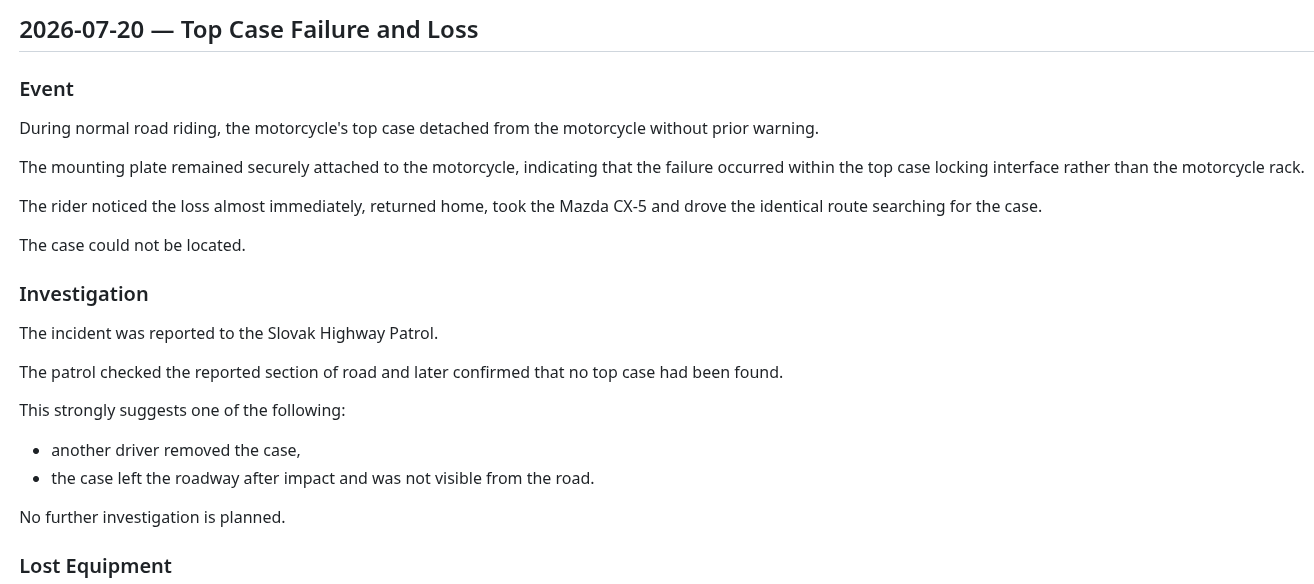
I treated it as an incident.
I documented it.
Full description.
Severity.
Circumstances.
Likely cause.
Immediate resolution.
Photos of the broken holder.
Photos of the rear motorcycle frame.
Follow-up checks.
Missing items.
Future precautions.
Years from now, I will not vaguely remember:
There was some problem with the top case once.
I will know when it happened, what probably happened, what damage was visible, what I did next, and what checks I added to reduce the chance of repetition.
That is the aviation paper-trail mindset scaled down to a motorcycle.
Not because the motorcycle needs aircraft bureaucracy.
But because the principle is useful:
unknown state is risk.
The incident becomes knowledge
This is the part most people miss.
An incident without documentation becomes a story.
An incident with documentation becomes knowledge.
A story fades.
Knowledge compounds.
If a similar holder shows stress marks later, I know what happened before.
If I buy a replacement, I know what failed.
If I sell the motorcycle, I can explain the history.
If I inspect the frame, I know which area deserves attention.
If I prepare for a longer trip, I know that the top case mount is not something to trust blindly.
That is the difference between owning an object and operating a system.
The object is still the same motorcycle.
But the owner is different.
Learn the maintenance, own the tools
There is another layer.
I am slowly building my own small repair shop.
Only for myself.
Nothing heroic.
No fantasy that I will suddenly become a professional mechanic.
The goal is simpler:
I want to understand my machines better.
I want to do parts of regular maintenance myself.
Motorcycle chain maintenance.
Oil changes.
Simple checks.
Cleaning.
Inspection.
Basic diagnostics.
Maybe eventually more.
The goal is not to do everything all the time.
The goal is to know enough that I am not helpless.
If repair shops are full for weeks, I want options.
If a technician explains a problem, I want to understand what he is saying.
If someone recommends a repair, I want to know whether it makes sense.
If I choose to pay someone, I want it to be because I am busy, because they are better, or because the task deserves professional equipment and experience.
Not because I have no idea what is happening.
That mindset changes the relationship.
You can talk to repair shop technicians almost as peers.
Not equal specialists.
But informed owner to specialist.
That is very different from helpless customer to black-box service provider.
Start with the motorcycle
For me, the motorcycle is the natural starting point.
It is simpler than a car.
More exposed.
Easier to inspect.
Easier to understand visually.
The chain is visible.
The brakes are visible.
Many components are reachable.
The machine teaches you faster because less is hidden.
I recently paid for thorough diagnostics and maintenance on the motorcycle to establish a stable state.
I treat that as a checkpoint.
From that moment, I take more responsibility.
The next oil change on my motorcycle will be done by me.
When the time comes, I will prepare.
I will use procedures.
I will use checklists.
I will use the right tools.
And of course, I will document everything.
That does not mean I will never use a repair shop again.
It means I know where the responsibility lives.
With me.
Safety is part of sovereignty
There is a dangerous version of DIY culture where people confuse sovereignty with pretending expertise.
That is not what I mean.
Some tasks deserve professionals.
Brakes, steering, suspension, fuel systems, airbags, structural damage, high-voltage systems, and many engine repairs should not be treated casually.
If you do not know what you are doing, do not improvise on safety-critical systems.
Sovereignty does not mean arrogance.
It means responsibility.
Sometimes responsibility means doing the work yourself.
Sometimes it means documenting the issue well and paying the right person.
Sometimes it means refusing a shortcut.
Sometimes it means asking for a second opinion.
Sometimes it means admitting that the professional has tools, experience, and pattern recognition you do not have yet.
The difference is that you remain the owner of the system view.
Own the records, rent the labor
This is the same principle as my infrastructure thinking.
In another context, I described my preferred architecture as:
own the core, rent the edge
For vehicles, the equivalent is:
own the records, rent the labor
The records are the core.
The service history is the core.
The current state is the core.
The inspection history is the core.
The incident log is the core.
The manuals, procedures, photos, invoices, and summaries are the core.
Repair shops are the edge.
They provide skill, equipment, time, diagnostics, lifts, tools, and experience.
You can rent that.
You can switch providers.
You can use different specialists.
You can do some work yourself.
But if the records are scattered outside your control, you do not own the operational truth of the machine.
Sovereignty has a cost
The trade-off is real.
One extreme is to specialize deeply in your job and delegate everything else to other people.
That can work.
The other extreme is to do everything alone.
That usually does not scale.
The middle ground is better:
learn enough about the things around you.
Own tools where it makes sense.
Attempt basic maintenance when it is safe.
Understand the machine.
Keep records.
Document incidents.
Use professionals intentionally.
Pay for expertise when appropriate.
Pay for speed when you are busy.
Pay for specialized equipment when it would be foolish to replicate it.
But do not pay because you are blind.
That is the whole difference.
The final principle
Vehicle sovereignty is not about never visiting a repair shop.
It is not about becoming a full-time mechanic.
It is not about distrusting every technician.
It is not about turning your car into an aircraft bureaucracy.
It is about knowing the state of the machine you own.
It is about keeping the audit trail.
It is about being able to brief any repair shop properly.
It is about being able to change contractors without losing history.
It is about turning incidents into knowledge.
It is about having enough skill and tools that convenience remains a choice, not a dependency.
The principle is simple:
Pay because you are busy, not because you are helpless.
Own the machine.
Own the records.