Normally I publish all my articles on LinkedIn.
This one will be the first not to appear there.
You'll understand why very quickly.
I am about to criticize something LinkedIn rewards heavily: the illusion of wealth.
Or as I like to call it:
The Imitation Game.
Yes, I borrowed the title from the movie about Alan Turing. It felt appropriate.
The Trigger
I follow many startup founders, investors, and venture capitalists.
Even though their operating model is fundamentally different from mine, we share something important.
We want to build things.
We want to create impact.
We want to leave something behind that makes the world slightly better than we found it.
But there is one area where our paths diverge dramatically.
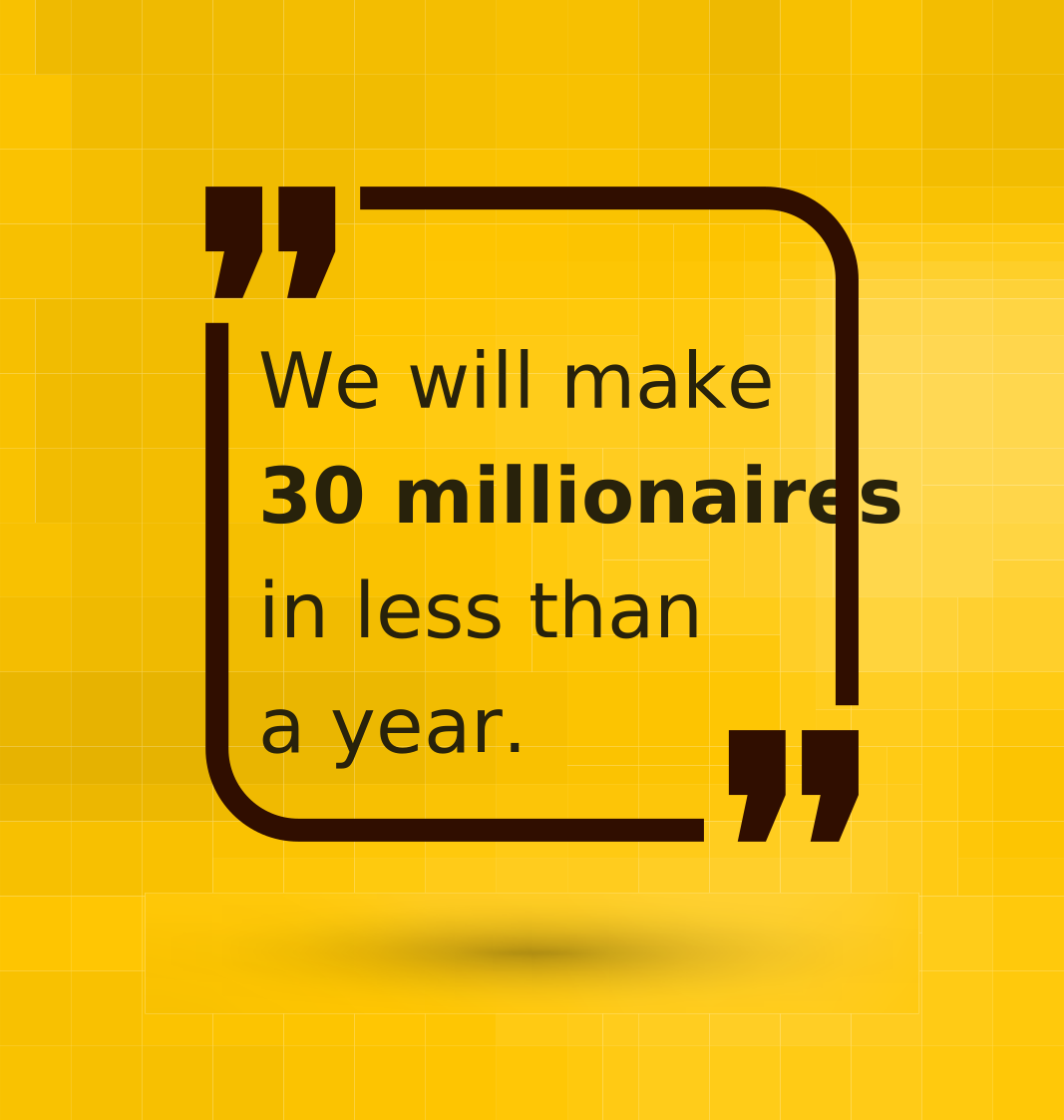
Recently I saw a founder proudly claiming they would create thirty millionaires within a year.
The statement caught my attention.
Not because it was impossible.
Because it was technically true.
And at the same time deeply misleading.
Paper Wealth and Real Wealth
One of the strangest things about the modern economy is how often we confuse valuation with money.
A company valued at ten million euros does not contain ten million euros.
A founder whose shares are theoretically worth a million euros is not necessarily a millionaire.
A startup employee with stock options is often not wealthy at all.
Most of this wealth exists only on paper.
It is a prediction.
A possibility.
A promise about the future.
Sometimes the promise becomes reality.
Sometimes it evaporates completely.
Yet media, investors, and even founders often talk about these numbers as if they were cash sitting in a bank account.
They are not.
The Startup Conveyor Belt
The startup world has developed its own progression system.
Pre-seed.
Seed.
Series A.
Series B.
Series C.
Exit.
Each round brings more money.
Each round increases expectations.
And each round usually reduces the founder's ownership.
With every investment round, you own a smaller fraction of the same pie.
Investors understand this game very well.
Most startups fail.
They know that.
The model works because a small number of successful companies compensate for many unsuccessful ones.
For investors it is a portfolio.
For founders it is their life.
That distinction matters.
The Cost Nobody Puts in the Headline
The optimistic scenario is easy to imagine.
The company grows.
The valuation increases.
An acquisition happens.
Everyone celebrates.
The founder becomes wealthy.
But there is another side to the equation.
Five years.
Ten years.
Constant pressure.
Fundraising.
Hiring.
Layoffs.
Deadlines.
Competition.
Responsibility.
A founder is often told they are building freedom.
What I frequently observe is someone sacrificing freedom today for a possibility of freedom tomorrow.
And that possibility is never guaranteed.
The startup might succeed.
The startup might fail.
The valuation might become real money.
Or it might disappear entirely.
Potential is cheap.
Reality is expensive.
Chasing Freedom by Sacrificing Freedom
This is the point where my thinking diverges from much of startup culture.
I understand ambition.
I understand wanting impact.
I understand wanting to build something meaningful.
What I don't understand is sacrificing an entire decade of life for a possibility that may never materialize.
Many founders work extraordinary hours.
Relationships suffer.
Health suffers.
Hobbies disappear.
Life gets postponed.
All for an exit that may or may not happen.
Even when it does happen, many don't stop.
One million becomes ten.
Ten becomes one hundred.
The game simply continues.
At what point does wealth become enough?
I don't know.
But I rarely see people asking that question.
Why I Refuse to Play
For years I thought I wanted a startup.
The deeper I looked into the system, the less appealing it became.
I left the corporate world because I didn't want somebody else determining how I spend my time.
Ironically, many founders end up with a different set of bosses.
Investors.
Boards.
Fundraising cycles.
Market expectations.
I realized I didn't want that either.
So I chose a slower path.
No investors.
No fundraising.
No pitches.
No growth targets imposed from outside.
Just building.
The obvious trade-off is speed.
I will move slower.
Much slower.
What I gain is something I consider more valuable.
Time.
Autonomy.
Freedom.
The ability to build according to my own rhythm.
The Wealth I Actually Want
I am not anti-entrepreneurship.
I am not anti-business.
I am certainly not anti-building.
I simply define wealth differently.
To me, wealth is not a valuation.
It is not a Forbes list.
It is not a paper estimate of what I might one day possess.
Wealth is having enough resources to fund the life you want while still having the freedom to live it.
That freedom does not begin after an exit.
It begins the moment you stop postponing your life.
That is the game I chose to play.
And unlike paper wealth, I don't have to wait ten years to know whether it exists.