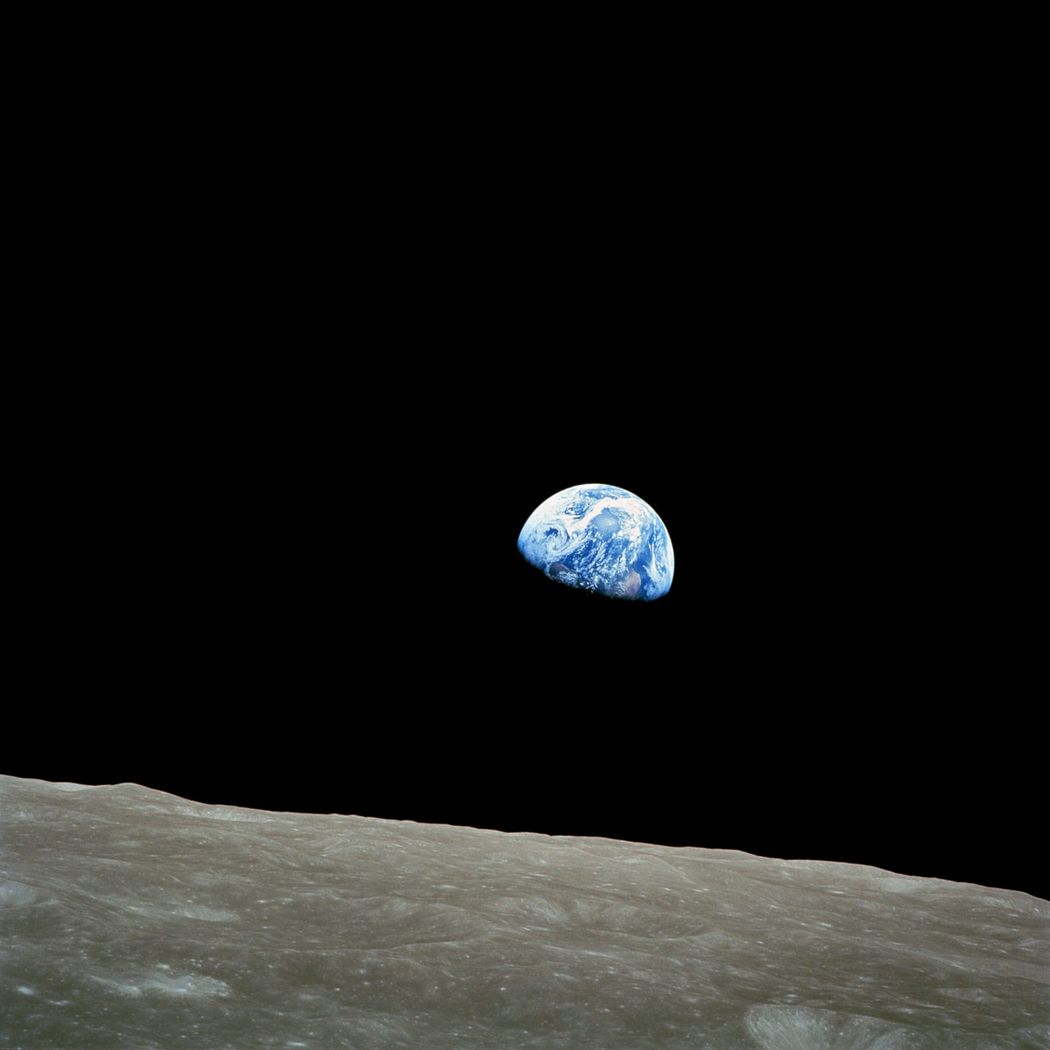
Somehow, Jim Lovell's words came to mind, in Tom Hanks' voice: “We just lost the Moon!”
He said that to the crew of Apollo 13 after it became clear they weren't going to land on the Moon. In seconds, their mission changed its objective from landing on the Moon to saving their lives and bringing every astronaut safely back to Earth.
A huge monolithic vision might feel overwhelming
Visionary entrepreneurs dream big. I know I do. One thing I had to learn the hard way was the contrast between my visualized reality and the real world of 2026.

This never fully goes away. I feel like I already live in a world 20 years from now, where my dream has become reality.
This works because my mind has an anchor. Maybe this is the difference between people who create a small, proven business and people who dare to enter the land of dragons or lions...
I have realized that I will never fully escape my visualized world. No matter what I accomplish in life, my vision will always be bigger and farther away.
So the sanest thing to do was to accept this contrast as a permanent part of my life.
If you've never experienced this yourself and the world you're dreaming of and the world you're living in are about the same, maybe you've won at life. Or maybe it's just a different point of view. We all get different hands of cards.
Losing the Moon might be the necessary reframing
Until recently, I was holding my entire vision in my head, with a timeline of 30 years. Can I build what I've spent months drafting on paper? How much of it can be materialized?
Maybe these are not the right questions to ask.
I prepared execution strategies, but my progress has been slow. I just lost one year broadcasting into the void on LinkedIn. Maybe I should have pivoted sooner, but this was part of my learning. With real opportunity costs.
Now I face another obstacle. I still don't have a stable revenue stream, not even for myself. Instead of executing my monolithic plan, I am forced to adapt to reality.
And so, just a few days ago, I decided to mentally put the whole vision into an archive. Just like when you archive your old emails.

The purpose is to release my cognitive resources for things that need my attention now.
Instead of working on something extremely huge alone, I suddenly feel free. My objective has changed to developing a narrow product and securing funding. My grander idea is safely parked and documented. I can return to it in the future once my circumstances change for the better.
I just lost the Moon.
Like the Apollo 13 astronauts, I now need to focus on survival.
Entrepreneurship as a space program
Here comes my biggest eureka moment. Until now, I was working on my vision as one giant mission. And I placed too much importance on that mission succeeding.
I should pay more attention to the way NASA used to do things, especially during the Apollo era. President Kennedy gave them a task: land a man on the Moon and return him safely to Earth before the end of the decade.
But where to start? How do we get there? This is too complex to be handled by one grand mission. Instead, NASA worked toward this objective through a succession of missions, building on earlier programs and involving hundreds of thousands of people.
Here's my reframing:
I lost the Moon on my current mission. However, Apollo 13 wasn't the only mission. In fact, Apollo 1 ended in a far greater tragedy, killing three astronauts during a ground test. The disaster led to major changes in spacecraft design and safety procedures.
The useful insight for business and entrepreneurship is to treat your venture as a series of space program missions. You might even label them. Once a mission is completed, you get closure. Then you might start preparing for another mission, and another...
Give your mission a clear, narrow objective
Every Apollo mission had its own objectives. Testing spacecraft in Earth orbit, rendezvous and docking with the lunar module, flying around the Moon, actually landing on its surface... and later exploring the Moon's geology.
As the missions progressed, the space program became less exciting to the public. Landing on the Moon became almost normal. Meanwhile, the later missions expanded the scientific exploration.
What are the objectives of my current mission? I have two:
- Prepare a product and sell it through paid advertising. As someone without a large following, I have decided not to depend on building an audience first.
- Find out whether one can build an audience without picking a niche.
The first is my commercial mission. The second is a personal experiment running alongside it.
Missions can be cancelled, postponed or swapped. Deal with it.
Becoming an astronaut who was supposed to fly to the Moon was almost like winning a lottery ticket. NASA had many skilled astronauts but only a handful of seats.
Even if you got picked, it didn't mean you would get your chance to fly. Ken Mattingly was removed from Apollo 13 shortly before launch because he'd been exposed to German measles. He never developed the disease, and later flew on Apollo 16. Other astronauts had their missions cancelled completely.
This is part of life.
I might never reach the Moon.
With plans as ambitious as mine, anything can happen. But I think I've finally accepted uncertainty as part of this game.
I will plan my own missions. Some will fail but teach me something, some will succeed and some might get cancelled.
Whether I reach my Moon is still an open question. This first failure wasn't the end of it. It was rather a warm-up.
Footnote: The Atlas Program
My space program won't be named after Apollo, although I do like NASA's names, such as Mercury and Gemini. Apparently, Google liked the latter too.
I've decided to name my missions after Atlas, the Titan from Greek mythology who was condemned to hold up the heavens. In a way, he represents the gravity of carrying my entire vision on my shoulders.
This time, however, the burden is neatly divided into smaller missions.
Atlas 1 has failed. Atlas 2 has just begun.