This post might be polarizing.
Not because I want it to be.
But because it touches a topic where many people have already picked a side.
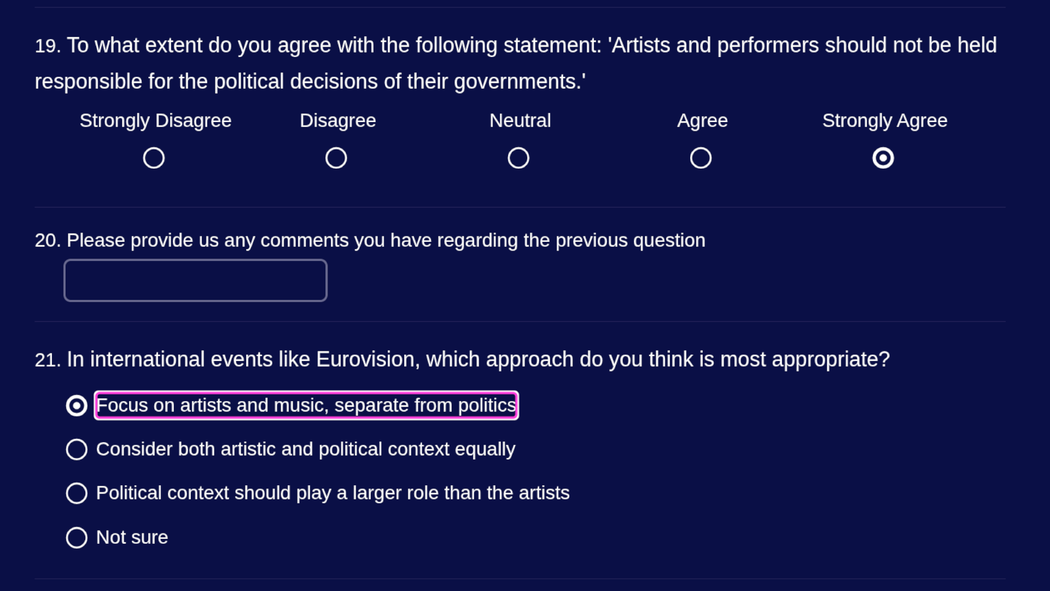
A few days ago I received an email from the Eurovision Song Contest. As a long-time fan of the show, I gladly participated in their survey about its future.
Most questions were expected.
Then one caught my attention.
The organizers were asking whether artists should be held responsible for the political actions of their countries.
For me, this question goes far beyond Eurovision.
It touches a pattern I see everywhere.
The Individual vs The Group
I have always struggled with one idea.
The idea that a person should inherit responsibility for actions they did not personally take.
Not because I believe people should avoid responsibility.
Quite the opposite.
I believe responsibility should be as individual as possible.
When I meet a Russian, I don't meet Russia.
When I meet an American, I don't meet America.
When I meet a Slovak, I don't meet Slovakia.
I meet a human being.
Someone with their own beliefs, experiences, mistakes, values, and dreams.
Yet modern society increasingly encourages us to think in categories.
Nationality.
Political affiliation.
Religion.
Gender.
Profession.
We often decide who somebody is before we even meet them.
The Shortcut
I understand why this happens.
The human brain loves shortcuts.
Groups are easier to process than individuals.
Evaluating one person takes effort.
Evaluating a category takes seconds.
The problem is that shortcuts often sacrifice accuracy.
Every nation contains millions of unique stories.
Every political movement contains people who disagree with each other.
Every community contains both admirable and terrible individuals.
Reality is messy.
Categories are tidy.
And humans naturally prefer tidy.
The Cost of Collective Thinking
The danger appears when we stop treating categories as tools and start treating them as reality.
Once that happens, people disappear.
Only labels remain.
The conversation changes from:
"What did this person do?"
to
"Which group does this person belong to?"
That shift may look small.
It isn't.
Because one question invites curiosity.
The other invites prejudice.
Eurovision Was Just The Trigger
The Eurovision survey simply reminded me of this pattern.
The same question appears everywhere.
In sports.
In business.
In media.
In everyday life.
How much of a person do we judge based on their actions?
And how much do we judge based on the groups they happen to belong to?
I don't claim to have the perfect answer.
But I know the direction I prefer.
Whenever possible, I try to judge individuals as individuals.
Not because it is easy.
Because it is harder.
Because it requires more thought.
Because it requires resisting convenient shortcuts.
And because, in my experience, it leads to a more accurate understanding of reality.
The Bigger Picture
Politics often divides people into camps.
Us versus them.
Good versus bad.
Right versus wrong.
But most people I have met don't fit neatly into any camp.
They are more complicated than that.
Perhaps the healthiest thing we can do in an increasingly polarized world is surprisingly simple:
Look at the individual before the label.
The label might tell you something.
The individual tells you much more.