Most educational videos today are produced through improvisation.
A presenter opens a screen recorder, starts talking over vaguely prepared material, occasionally adds a webcam overlay in the corner of the screen and publishes the result.
It is fast.
It is cheap.
And usually it shows.
Most educational videos stop at screen recording.
The problems are familiar:
- filler words
- pauses and thinking out loud
- monotone pacing
- lack of narrative structure
- weak visual support
- poor correction possibilities
- and educational fatigue after a few minutes
This approach treats educational media as disposable content.
But during recent work on Eledo Academy, I realized something interesting.
Without fully intending it, we started building something very different:
a Git-native educational production system.
Educational videos are not about the presenter
One of the biggest misconceptions around educational content is the idea that authenticity means minimal preparation.
In practice, this often becomes an excuse for sloppy production.
Educational media should not revolve around the presenter.
The goal is not:
- self-expression
- personality-driven content
- or “content creation” itself
The goal is:
directed educational transmission.
Every second of the viewer’s attention matters.
That changes the priorities completely.
Suddenly:
- pacing matters
- structure matters
- transitions matter
- subtitle quality matters
- visual clarity matters
- and preparation matters enormously.
The presenter becomes only one layer of a much larger system.
What professional educational production actually looks like
As part of my research, I spent time analyzing educational videos produced by companies like Google for Android developers.
The difference is immediately visible.
Not because they use expensive cameras.
Because the videos are orchestrated.
They are:
- scripted
- paced intentionally
- visually synchronized
- and built from multiple independently controlled layers.
Presenters often use teleprompters.
Not because they are “fake.”
Because it allows them to:
- maintain rhythm
- reduce cognitive load
- eliminate filler words
- preserve eye contact
- and focus on delivery.
Visuals are also not random.
Animations, zooms, highlights, overlays and transitions are coordinated to support the narrative rather than merely decorate the screen.
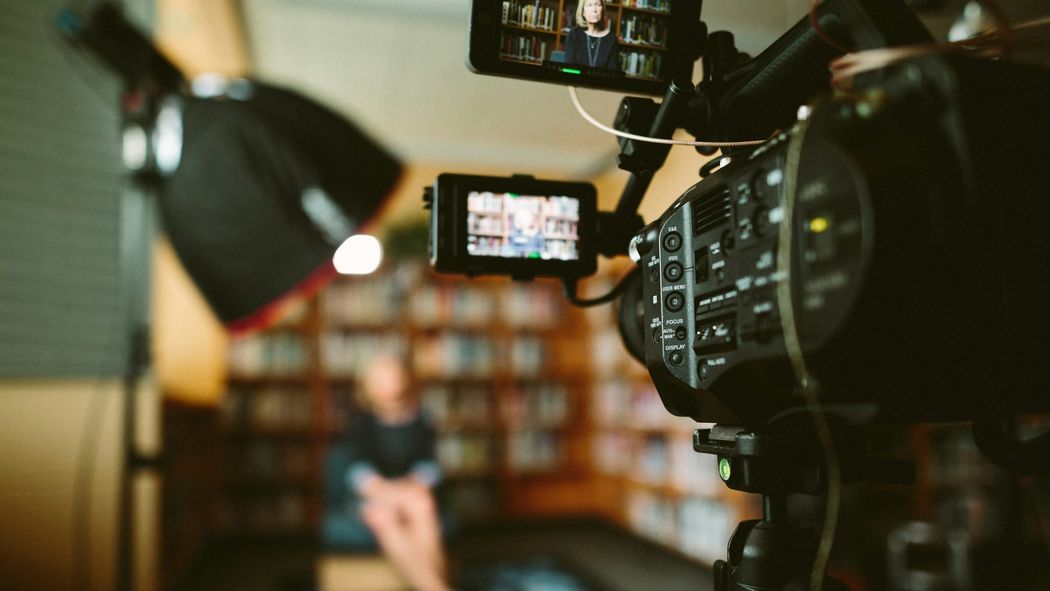
This is much closer to film production than improvised screen recording.
Professional educational media is orchestrated.
The moment educational media becomes infrastructure
The biggest realization came later.
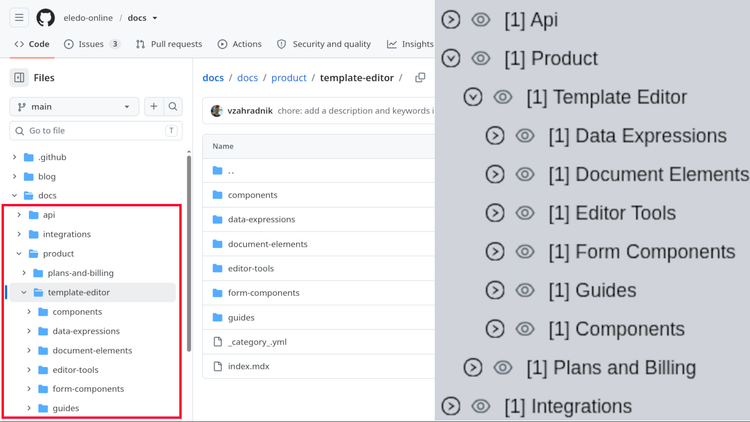
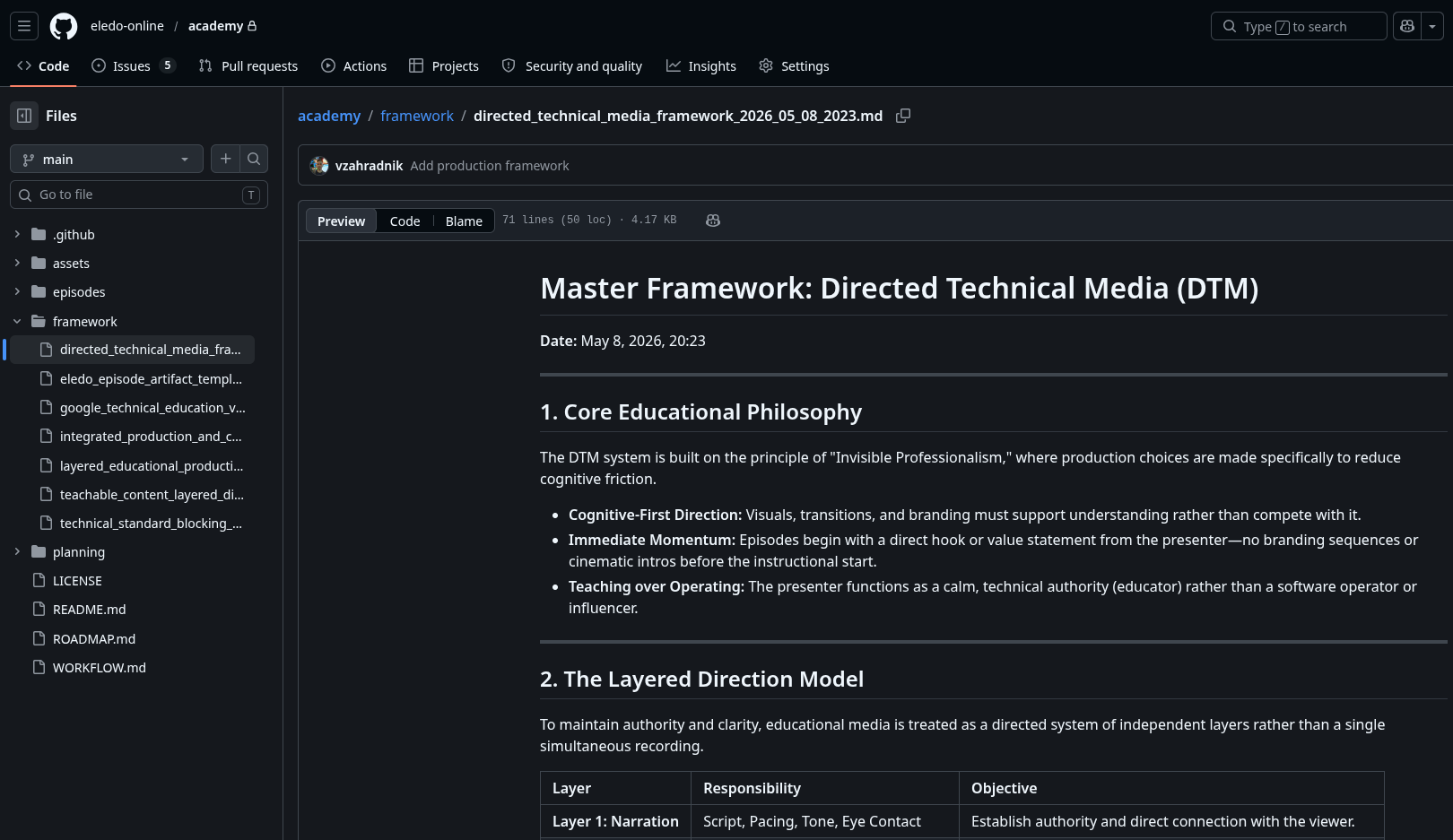
The Eledo Academy repository no longer contains only:
- scripts
- assets
- or rough planning notes.
It now contains:
- directing standards
- subtitle policies
- choreography protocols
- production doctrine
- layered production models
- adaptive layout systems
- educational architecture
- and synchronized editorial workflows.
At some point, the repository stopped feeling like “media files.”
It started feeling like infrastructure.
And this changes everything.
Modular production instead of one giant recording
Traditional educational video creation often treats production as one monolithic process:
- Press record
- Talk for 20 minutes
- Edit mistakes
- Export video
The problem is that everything becomes tightly coupled.
If one part is weak:
- pacing collapses
- corrections become painful
- visual consistency suffers
- and reuse becomes difficult.
A production-oriented system works differently.
The process becomes modular.
For example:
1. Script layer
A complete narration script optimized for teleprompter reading.
Not vague notes.
Not bullet points.
Actual spoken language.
2. Directing layer
A separate production document describing:
- timing
- transitions
- overlays
- animations
- visual actions
- scene intentions
For example:
| Timestamp | Action |
|---|---|
| 00:00:01 | Insert speaker title lower-third |
| 00:00:40 | Start animated transition |
| 00:01:10 | Highlight UI component |
This immediately reduces ambiguity during editing.
3. Storyboard layer
Complex concepts are translated visually before production starts.
Sometimes sophisticated.
Sometimes just pen and paper.
The important part is not artistic perfection.
It is visual thinking before recording.
4. Scene segmentation
Scripts are broken into independent production segments.
This allows:
- cleaner editing
- targeted retakes
- synchronized visuals
- and modular post-processing.
The presenter is no longer recording blindly.
They understand what will happen on screen during each segment.
Your videographer will immediately feel the difference.
Software engineering accidentally prepared us for this
What fascinates me most is how naturally software engineering concepts transfer into educational production.
Educational media suddenly becomes:
- version-controlled
- modular
- auditable
- layered
- maintainable
- reviewable
- and scalable.
The similarities are surprisingly strong.
Scripts resemble source code.
Production doctrine resembles architecture documentation.
Storyboards resemble UX flows.
Scene segmentation resembles modular decomposition.
Even pull requests start making sense.
Invisible professionalism
The irony is that when this system works properly, viewers often do not consciously notice it.
They simply experience:
- clarity
- rhythm
- lower cognitive friction
- visual coherence
- and smoother learning.
The professionalism becomes almost invisible.
Which is exactly the point.
The next phase
After building a production-ready n8n integration and restructuring the documentation system itself, I am now slowly moving toward a directing role within the project.
The first 10 educational videos were already commissioned.
And interestingly, the production pipeline already feels:
- scalable
- navigable
- intentional
- and operational
before the first real episode is even produced.
That is likely because the system was designed as infrastructure first and media second.
And honestly, I believe educational content deserves that level of care.