First came LLM chatbots. Suddenly, people with very little programming experience could create software by describing what they wanted.
But there was a limitation. Chatbots could help write code, yet someone still had to guide the process and put the results into action.
Then came AI agents.
Agents can use tools, execute commands, interact with existing software, and perform multi-step tasks with varying degrees of autonomy.
And yes, that includes SaaS platforms.
There are countless SaaS products that were developed long before AI agents became a reality. Perhaps yours is one of them.
You've built your platform, exposed a public API, and perhaps even developed integrations with automation platforms like Zapier or n8n.
But here's a question:
How easily can an AI agent actually use your SaaS?
A public API is a great foundation. But agents also need an accessible, reliable way to interact with it. Depending on the environment, that might be a command-line interface (CLI), an MCP server, or another tool integration.
And this is where things get interesting.
A CLI I Didn't Build for AI Agents
A few months ago, I developed a command-line interface for a small SaaS platform specializing in PDF document generation.
I was originally hired as a consultant by the founder. The CLI, however, was my own initiative.
I had been developing an integration for n8n, a workflow automation platform. During development, I frequently needed to inspect the SaaS API, test different operations, and understand how the service behaved.
My tool of choice was curl.
It worked. But repeatedly constructing requests with carefully prepared payloads was tedious and impractical.
I had used command-line tools extensively before, including AWS CLI. I had also co-developed an internal CLI for a former client.
So I thought: why not build one for this SaaS?
The API wasn't particularly large, and by then I understood it quite well.
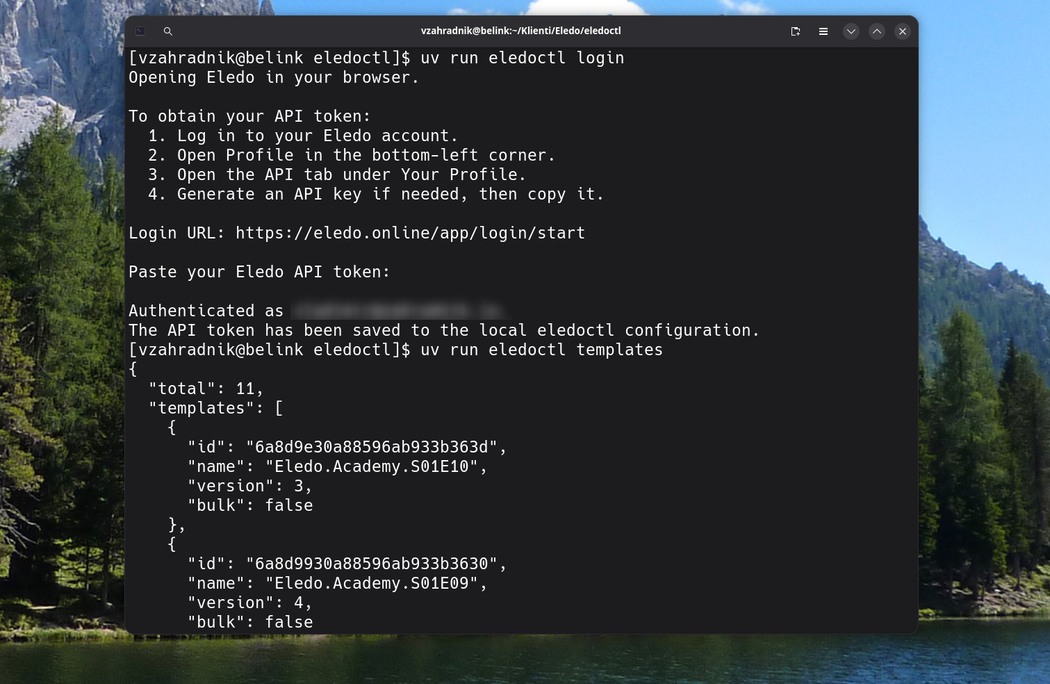
I decided to create eledoctl, a command-line tool inspired by the design principles of AWS CLI.
But I didn't want to simply translate every API endpoint into a command.
A good CLI is not just an API wrapper. It's an interface designed around what users actually want to accomplish.
Not every API method needs to be exposed. Sometimes a single command should orchestrate several API operations. Ideally, the tool hides unnecessary complexity rather than forcing users to understand the implementation details.
The result was a practical tool for interacting with the service directly from a terminal.
And I hadn't even considered AI agents.
Why This Matters for Your SaaS
A well-designed CLI can provide several advantages.
1. Developers can work directly from the terminal.
Many developers prefer command-line tools for automation. They can write scripts, repeat operations, and integrate your service into their existing workflows without navigating through a browser.
2. Your SaaS becomes easier to integrate into DevOps workflows.
Imagine scheduled jobs, deployment scripts, or CI/CD pipelines interacting directly with your service.
3. Your SaaS can become part of a larger toolchain.
If your CLI accepts structured input, produces machine-readable output, and handles errors predictably, it can work alongside other command-line utilities.
4. AI agents may be able to use your SaaS too.
Many coding agents already have access to a terminal. Given a well-designed CLI, appropriate documentation, and properly scoped permissions, they can potentially interact with your service without navigating its graphical interface.
Consider a SaaS platform that generates PDF documents.
You could ask an AI agent:
"Generate five documents using these templates, download the results, and organize them into folders."
With the right integration, the agent could perform that workflow by invoking the CLI.
You wouldn't need to manually open the website and repeat the same operations five times.
This is a hypothetical example, not a claim that I've already implemented this exact agent workflow.
Of course, exposing commands alone isn't enough.
An agent-ready integration needs reliable authentication, predictable machine-readable output, clear error handling, and properly scoped permissions.
You don't want an AI agent to have unrestricted access to your customers' data or administrative operations.
A tool originally designed for developers can become an interface for AI agents—but it needs to be engineered accordingly.
CLI or MCP?
You may have heard about the Model Context Protocol (MCP), which allows compatible AI applications to discover and invoke tools exposed by external services.
So should you build a CLI or an MCP server?
It depends.
A CLI is particularly useful for developers, shell scripts, CI/CD pipelines, and agents that can execute commands.
An MCP server offers structured, discoverable tools for compatible AI clients, potentially without requiring a local executable.
They aren't mutually exclusive.
In fact, both can share the same underlying API client or SDK.
That means you don't need to implement your business logic twice. Instead, you build a reliable integration layer and expose its capabilities through whichever interfaces make sense for your users.
Ultimately, the objective isn't to adopt another fashionable technology.
It's to make the capabilities of your SaaS accessible to the tools people already use.
The Industry Is Moving
In 2026, Google introduced Android CLI, bringing Android development tools and workflows to the terminal with explicit support for AI-assisted development.
That's a meaningful example of a major platform investing in agent-accessible developer tooling.
I expect we'll see more of this across software ecosystems.
And it brings me back to an important principle.
The most valuable investment may be a well-designed integration layer, not another AI feature.
Think about it.
You've spent years developing your SaaS. You have business logic, workflows, and useful features.
But even with a public API, those capabilities may not be particularly convenient for developers, automation systems, or AI agents to use.
You don't necessarily need to rebuild your SaaS around artificial intelligence.
Sometimes, you simply need to make the capabilities you've already developed accessible to the tools—and agents—that people are increasingly using.
Let's Build the Missing Connection
I've developed SaaS integrations, command-line tools, and API-based developer tooling, including the n8n integration and eledoctl described in this article.
My work is open-source, so you can inspect the implementation yourself.
If you're building a SaaS platform and want to make it more accessible to developers, automation systems, or AI agents, I can help you design and implement that integration.
Let's talk.